

(
0
)
Your bag


Your bag is waiting for something special.
Start Shopping
Product is not available in this quantity.


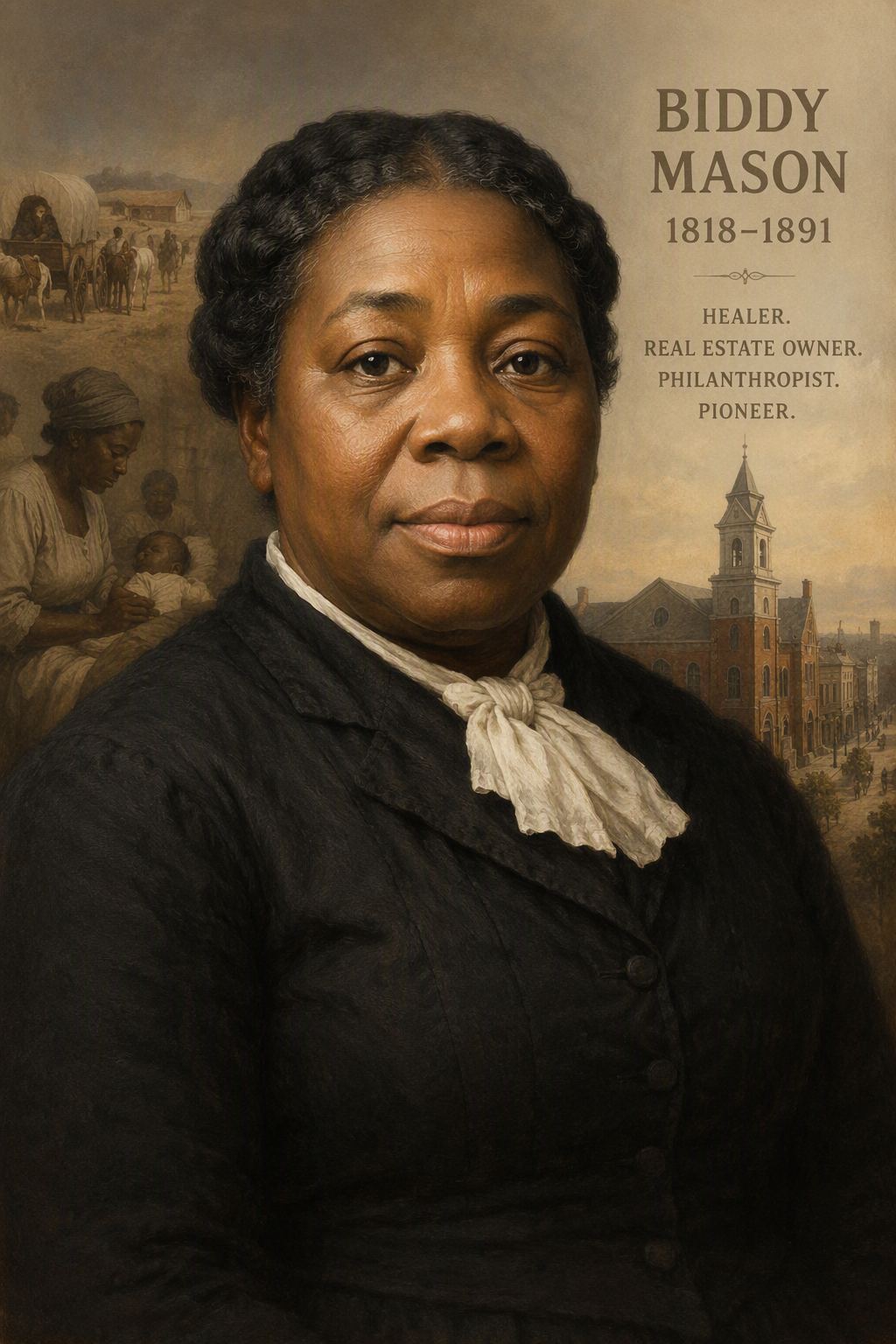
The Long Cure of Biddy Mason
Born in the heat and dust of the Georgia clay in 1818, BiddyMason’s life began under the weight of bondage. She was born enslaved, with nolast name, no choice of root or branch. The world named her property, told herhands what to do, told her body where to belong. Yet even then, something inher bore quiet, unacknowledged promise.
The early burden
The fields of the South demanded her strength. As a girl shelearned more than domestic service: midwifery, herbal remedies, animal care,those hand-skills of survival born deep in the womb of oppression. Theplantation taught her that some hands heal, even as they pick cotton. Theenslaved women around her passed down ancient knowledge (old African and otherroots) in hushed voices between the labor, moment to moment. After all, thebody of another may lie beneath your own hands, and you learn what it means tobring life.
When her enslaver, Robert Marion Smith (a Mississippi-Mormonconvert) set his sights west, Biddy — pregnant or with young daughters already— was among the human cargo carried. In 1848 she walked behind a wagon train ofsome 300 vehicles, from Mississippi toward the Salt Lake Valley. Livestock,wagons, dust, hunger, hope — a 1,700-mile plus trek. Along the way, Biddycooked, set up camp, tended animals, midwifed children whose names she did notknow. (NationalPark Service)
This was where the metaphor of your soap begins: the oliveoil steeped in bay-leaf, the slow maturation of tension into fragrance, ofsuffering into fruit. Every mile Biddy walked, every night camp-fire she rosewith, every child she delivered or comforted — like an infusion of time andstrength.
Arrival in a “free” land and the challenge of bondage
In 1851 the caravan arrived in the San Bernardino region ofCalifornia. By then the state constitution forbade slavery; California had beenadmitted to the Union as a free state in 1850. Yet, for Biddy and many others,freedom was still elusive when their owner dragged them across the continent. (HowStuffWorks)
When Smith declared in 1855 that he would move his“property” (including Biddy and her daughters) to Texas — a slavery-state — herevealed that he regarded them still as chattel, even in a free state. But atthat moment, friends stepped in. Free Black men in the region, includingCharles Owens, a young free man who courted Biddy’s daughter Ellen, and others,recognized the danger of losing their friends and kin from the territory. Theyinsisted on legal action. (NaturalHistory Museum)
Despite the odds — black people in California were oftenbarred from testifying against white people; enslaved women had minimal legalstanding — Biddy’s case went before Judge Benjamin Ignatius Hayes. On January21, 1856, the court ruled that neither slavery nor involuntary servitude waspermitted in California, and thus Biddy Mason and her daughters were free. (NationalPark Service)
For the soap brand narrative: this is the turning-point.Time, which had stretched long and slow for decades, at this moment bent towardjustice. What had been raw, rough, labor-laden soil became ground for healing.The bar you craft echoes this moment: the cure of olive oil after time, theinfusion of bay-leaf, the shift from hardship into freedom.
Patience planted, wealth grown
Once free, Biddy did not rest. She and her daughters movedto Los Angeles. She worked as a midwife and nurse, trusted in the community.With her herbal knowledge, she tended the sick, delivered hundreds of babiesacross racial lines, opened her home to the needy, and also visited prisoners.(freedomcenter.org)
Often it was small accumulations: every delivery, everysaved dollar, every prayer answered became seed. She bought her first parcel ofland in 1866 (or around then) for $250 — one of the first Black women to ownproperty in the city. (HowStuffWorks)
Over time, her land increased in value as the city aroundher grew. Properties she held near Spring Street (in downtown LA’s futureheart) appreciated. She sold portions for thousands and re-invested. By thetime of her death in 1891 her estate was valued at roughly $300,000 (equivalentto many millions today). (freedomcenter.org)
In your soap’s language: imagine the olive oil, kept cold,slow-infused with bay-leaf, then poured into molds. Over time the bars cure,the fragrance deepens, the lather softens — what was once sharp becomes fine.So it was with Biddy: what began as survival became sanctuary; what began asslavery became legacy.
The event: claiming the land and opening the door
Let’s linger on one event that crystallizes this victory:the purchase of land in downtown Los Angeles, and the founding of the firstblack church. In 1872 Biddy Mason, along with Charles Owens and other Blackresidents, founded the First African Methodist Episcopal Church of Los Angeles(FAME) — the first African-American-led church in the city. They heldorganizing meetings in her own home on Spring Street, and she donated the landfor the church building. (Wikipedia)
Picture this: a woman who had been property now ownedproperty; a building she gave became a house of gathering, faith, uplift. Shestood where she had once been rooted out. She laid the bricks where she hadonce carried burdens. And she welcomed the community inside. The soil aroundher had changed.
In another moment of public service: in 1884 a flash flooddevastated homes across Los Angeles. Biddy Mason opened a tab at the localgrocery store on Spring Street and instructed the grocer to provide food freelyto any person in need — Black or white. This act, small in monetary cost butmassive in moral consequence, echoed the slow-growth metaphor: a tree that tookdecades to root now offered shade to all. (HowStuffWorks)
The deeper meaning: aging into purpose
You asked for focus on how things age, getting betterwith time. Biddy’s life is this truth incarnate. A bar of Castile soap,made with olive oil and bay-leaf, cures over weeks and months: the oils stabilize;the scent rounds out; the bar hardens and lasts. In the same way, Biddy’s yearsof service, patience, frugality, investment, and generosity matured intocommunity transformation.
Her hands once forced to pick cotton now held infants andreadied wards; her body once walking behind wagons now owned land in the heartof a growing city. The slow accrual of property, the steady building ofgoodwill, the disciplined saving — all of it matured like fine soap.
Because of time, Biddy could offer something larger thanherself: a church, an elementary school, sanctuary for the poor, assistance toprisoners, land to sustain families. Her legacy outlasts her biography. Indowntown Los Angeles there is now the Biddy Mason Park, with an 80-footconcrete memorial wall titled “Biddy Mason’s Place: A Passage of Time.” (La Almanac)
Why this matters for your soap bar
As you cast the bar in cold process, infuse the olive oilwith bay-leaf, pour it into the mold, wrap it with your brand story: themetaphor is alive. The cure time (4-6 weeks, perhaps longer) is not a delay—itis the quiet work of transformation. Likewise, Biddy’s decades of unseen laborwere not waste—they were the alchemy of endurance.
When your customer lifts the bar, they are lifting more thansoap—they are lifting a story of root, of winding roads, of aged strength. Theylather not just for clean skin, but for touched soul. When the bar softens theskin, it echoes how Biddy softened the soil of exclusion around her; when thescent of bay-leaf rises, it whispers victory; when the bar lasts, it echoesrootedness.
Final reflection
In the closing years of her life, Biddy Mason was known as“Auntie Mason” or “Grandma Mason” — titles of love, not condescension. She diedon January 15, 1891, and was buried in an unmarked grave. Only decades laterwas a tombstone placed to honor her. (lkwdpl.org)
So the soap bar will say: yes, the growth may be slow; yes,the life may demand of us more than we imagine. But like olive oil infusedslowly, like bay-leaf steeped under time’s hush, like Biddy’s roots grown freeand deep — presence becomes power, time becomes texture, the once-worn becomesthe well-worn, the fully worn becomes the well-storied.
And in that way, agedness is not failing — it is thesecret ingredient of grace.
If you like, I can craft a draft label withfront/back copy based on this story, and a short version for socialmedia (Instagram / TikTok) that distills the message into soap-friendly copy.Would you like me to go ahead with those?
The Story:
Chapter One — The Unmixed Oils
“Child,” said the old woman, “time will do what heatcannot.”
“And what is that?” asked the girl.
“It will teach you how to wait without dying.”
Before she ever had a name of her own, Biddy was born intothe scent of red clay and smoke — Georgia soil after rain, iron-rich and warmbeneath bare feet. The fields rolled like waves, endless rows of cottonblooming under a sun that never stopped demanding.
The people around her spoke in two tongues: the crackedEnglish of survival and the low hum of something older — prayers whisperedbetween breaths, songs meant to sound like work but heavy with hidden meaning.In that hum, the girl learned rhythm. In that rhythm, she learned patience.
Her grandmother, they say, was a healer — the kind who couldpull fever from a child’s head with a rag steeped in willow bark and riverwater. When the night air filled with mosquitoes and sorrow, that woman wouldboil herbs over the fire, steam rising like ghosts of ancestors who refused tobe forgotten. Biddy watched her closely, memorizing the way leaves turned darkwhen they gave up their medicine.
She did not yet know that this was alchemy: takingwhat the world called worthless — roots, weeds, leftovers — and turning it intosomething that could save.
She grew into her hands early. Large, strong hands thatcarried water and children, caught babies as they entered the world, washed thedying before they left it. The overseers saw labor in those hands. Her peoplesaw blessing.
Time taught her one lesson over and over: nothing staysraw forever. Even pain, if left long enough, changes shape. Like the oilsher grandmother mixed — too sharp to touch at first, needing to rest until theymellowed into balm.
The woman who claimed ownership of Biddy called her“Bridget,” a name that never quite fit. It was too clean, too foreign, toosharp at the edges. Among her own people, she was just Biddy — soft, simple,shaped by use, like the wooden spoon her grandmother stirred salves with.
When she was twelve, she helped deliver her first baby. Themother screamed until dawn, the kind of sound that tears the night apart. Whenthe child finally came, slick and wailing, Biddy caught it barehanded. For amoment she thought the world had stopped — that all the noise of chains, heat,orders, and whipcracks had vanished. There was only that new cry, fierce andholy.
The older women nodded at her afterward. “You got thehands,” one said. “The good kind — not just for work, but for remembering.”
Remembering — she learned — was dangerous. The masterspreferred obedience to memory. But the old women carried stories in theirbones, and they taught Biddy how to hold them without speaking. “You can loseeverything but the knowing,” her grandmother whispered one night as theypressed herbs into oil. “They can’t burn that out of you.”
The oil hissed as it met the heat.
Biddy thought about how it changed — how the clear turnedcloudy, the scent grew stronger, sharper, alive. The oil had to hurt a littlebefore it could heal.
Years passed in that rhythm — work, prayer, waiting. Eachseason left its mark: the harvest blistered her palms; childbirth thickened herwrists; grief settled into her shoulders.
When she was grown, the woman who owned her followed herhusband westward — away from Georgia, away from everything familiar. They saidthe Mormons were going to build heaven in the desert, and they needed everyhand to do it.
So Biddy walked.
From Georgia to Mississippi, to the far territories beyondthe Mississippi River — step by step, thousands of miles. Her feet split. Herback ached. She caught and buried a child along the way. But she kept walking.
Each morning, before the wagons rolled, she gathered bayleaves when she could find them. Not for cooking — for strength. She’dchew one, let the bitter oil burn her tongue, and remember her grandmother’swords: time will do what heat cannot.
By the time they reached the strange new deserts of theWest, the girl who had been Biddy was a woman remade. She no longer trembledwhen ordered. She no longer waited for mercy. She had learned, quietly, towatch how things cured over time — how rough soap smoothed with age, how oilinfused deeper color after the fire cooled, how even sorrow lost its sting ifyou let it sit long enough.
She carried that knowing inside her like a hidden lamp.
One night, as the wagon train camped near the salt flats,she sat apart from the others, hands slick with lye and oil. She was cleaningthe lanterns, but it looked more like she was mixing something sacred. The windcarried her thoughts eastward — toward the people she’d left behind.
“If I live long enough,” she whispered to the dark, “I willmake something clean out of this life.”
No one heard her — except, perhaps, the stars.
They burned silently over the endless white plain, old assorrow, older than chains. And though she did not know it yet, time — thatpatient alchemist — had already begun its work.
Chapter Two — The Boil
“Every good thing must be burned before it shines.”
— saying of the old healers
The wagons moved like a slow-breathing beast across theland. Two hundred wheels grinding over stone and sage. The crack of a whipmarked the heartbeat. Dust rose thick as prayer smoke, clinging to hair, toskin, to the inside of the lungs.
Biddy walked behind the herd, the hem of her dress dark withsweat and mud. Each sunrise brought another mile. Each night she built thefire, boiled the water, soothed the crying, caught the babies that insisted oncoming even on the trail.
There were nights she thought the sky would break from theweight of stars. Out there, far from the cotton fields, the heavens seemedwider, louder — as if the ancestors had followed, whispering across the desertwind. Sometimes she thought she could hear her grandmother’s voice between thehooves and wheels:
Keep stirring, girl. Don’t let it settle.
The air was full of lye — alkali salt kicked up from theearth, stinging her eyes. She remembered how, in the making of soap, too muchlye could burn the skin but without it nothing transformed. It was all in thebalance, the right amount of heat and patience.
At the crossing of the Green River, the youngest boy of thecaravan fell ill. His mother wept, useless; his father prayed loud but empty.They called for Biddy — they always did when the doctors failed. She mixed whatherbs she could find, crushed sage and willow bark, wrapped the child in ablanket she’d soaked in warm water. She whispered the old songs under herbreath, the ones that were half-hymn, half-spell. By morning the fever broke.
“Thank you,” the white woman said, eyes averted, voicesmall.
Biddy nodded. She didn’t say what she was thinking — that healing had nevercared about color, only care itself.
Weeks turned into months. Utah’s cold bit like a blade.Biddy’s hands cracked from the wind. Still she worked — midwife, cook, herder,healer. Every task a stirring of the pot, every dawn another turn of the spoon.
Then came California: mountains like the backs of sleepinggods, air sharp with pine and promise. San Bernardino lay in a dry bowl of sun.The Mormon families spoke of it as Zion, a new Jerusalem. Biddy looked at thered-gold hills and thought: this land don’t belong to anyone but the earthitself.
But the law said otherwise. Robert Smith called her “hisproperty.” She was told to be grateful — California was “good land.” Yet sheknew that goodness means little when your soul is not your own.
Still, she worked. Delivered more babies. Saved her pennieswhen they let her. Listened to the market gossip. Learned who the free Blackpeople were in town, who might help, who would look away.
The heat had begun to rise.
In 1855 word came that Smith was leaving California. Hemeant to take all “his people” — including Biddy and her daughters — back toTexas. She heard the news while washing clothes in the creek. The water turnedcold around her wrists.
Texas. A slave state. The thought tightened her chest likerope.
That night she prayed, though not the way the preachers did.She spoke to her grandmother, to the wind, to whatever spirit listened in thatforeign desert. “I have come too far to be dragged back.”
Her eldest daughter, Ellen, watched her. “Mama, what we gon’do?”
“We wait,” Biddy said. “We let the boil finish. Then werise.”
The next days moved in silence. Wagons packed. Familieswhispered. Smith kept the women and children close. But Biddy had already setthings in motion. The free Black settlers of Los Angeles had heard of herplight. One, Charles Owens, rode out under cover of night to find her.
“Don’t you worry, Miss Biddy,” he said. “The law on yourside this time.”
He explained the plan: they would bring the matter before ajudge. Smith might have muscle, but California was free soil. All they had todo was reach Los Angeles.
When Smith’s caravan moved out, a sheriff’s posseintercepted them near San Bernardino. The writ had been served.
The hearing was held in January 1856. The courtroom smelledof sweat and pine tar. Biddy stood in a corner, silent but unbowed. She couldnot read, could not write, could not speak for herself by law — but she wasthere, and that was enough.
Judge Benjamin Hayes read from the papers. Witnesses spoke.The Smiths argued that Biddy was content, that she had chosen to stay withthem. Those who knew her truth stepped forward — free Black citizens,sympathetic whites, the community she had served with her hands.
When the gavel finally struck, the sound was like thunderafter a long drought.
“You are free,” the judge said.
For a moment, Biddy did not breathe. The room swam. Then theworld tilted, and she felt the weight lift from her shoulders — not gone, butchanged, as if the heat had burned away what could burn and left only whatwould last.
That night she walked alone under the California sky. Theair smelled of dust and sage and possibility. She opened her palms to the windand thought of all the things she would make now that the fire was behind her.
The boil was over.
What remained was the cure.
End of Chapter Two
Chapter Three — The Pouring
“Freedom is not the end of the work. It is the cooling ofthe mold, the forming of the shape.”
The day after the court set her free, the sun rosedifferently.
It was the same old California gold, but now it touched her skin withoutclaiming it.
The breeze through the sycamores felt like breath returned.
For the first time in her life, Biddy Mason could walk without askingpermission.
She did not shout or dance or run; her freedom began insilence.
The body that had been commanded for decades did not yet know how to move byits own choosing.
She simply stood in the road, her daughters beside her, and let the dust risearound their feet.
The world had not changed — only her place in it — but that was enough to turndust into light.
Los Angeles, 1856
Los Angeles was not yet the city of palm trees and glamour;it was a scattered settlement of adobe walls and dirt streets, horses tied tohitching posts, the air full of tarweed and orange blossoms.
For Biddy it was a blank mold, soft enough to take any shape.
She moved into a small rented room near Spring Street, not far from theriverbed, and began the work she knew best: catching babies, tending the sick,nursing the dying.
Word spread fast.
“She’s got healing in her hands,” the women said.
“She don’t take more than a fair coin,” the men added, “and she prays while sheworks.”
Each birth she midwifed left her with a few dollars,sometimes a chicken, sometimes nothing but gratitude.
She took whatever came, saved every coin, and poured her patience into the citythe way soap fills its mold — slowly, completely.
The Hands That Build
Her hands, once calloused by rope and cotton, grew deft withlinens and herbs.
She learned the new city’s medicines — camphor, quinine, sweet oil — but stilltrusted the roots and leaves she had carried from memory.
Sometimes she would walk down to the river, gather wild bay or sage, and infusethem in olive oil she kept in glass jars by the window.
When the sun hit those jars, the room filled with a scent like freedom itself:clean, green, and ancient.
The neighbors said the oil cured everything — coughs,fevers, the sadness that came after childbirth.
Biddy smiled but never sold it.
“It ain’t mine to sell,” she’d say. “It belongs to the ones who waited longenough to heal.”
The Shape of Freedom
She joined the small community of free Black families in LosAngeles — the Owens, the Bogans, the Petersons.
Together they formed a circle of safety: trading goods, watching one another’schildren, defending each other when the law looked crooked.
Biddy’s eldest daughter, Ellen, married Charles Owens — the same man who hadhelped secure their freedom.
The wedding was held under a pepper tree, its branches heavy with fruit thatsmelled of spice and rain.
Biddy wept quietly through the vows; not for sadness, but for the miracle ofwitnessing a union of choice.
Soon she was a grandmother, then again and again.
Her small room could no longer hold the life spilling out of it.
She moved to a lot on Spring Street — her first piece of land, bought with thesavings of countless nights of labor and prayer.
It was nothing but dry soil and scrub at first, but she stood there and sawmore: a home, a refuge, a beginning.
Owning that land felt like touching a new kind of sky.
The papers said her name now — Bridget Mason.
But in her own heart she whispered, Biddy still.
The name that had survived the fields, the desert, the court, the crossing —the name cured in truth.
The Pouring of Goodness
As the city grew, so did her circle of care.
She helped organize gatherings of prayer in her home — small at first, thencrowded enough that neighbors stood outside, singing through open windows.
In those meetings, she saw again what she had seen at every birth: that spiritenters where there is room to breathe.
The gatherings became the seed of the First African Methodist Episcopal Church— the first Black church in the city.
Biddy offered the ground itself, donating a piece of her own lot for thebuilding.
“Stone belongs to whoever lifts it,” she said when the menprotested.
They laughed, but they let her give it.
The church rose slowly, each wall a testimony to hands unbound.
When the first hymn was sung under that roof, Biddy stood inthe doorway, the scent of bay oil still on her skin, and thought how strangeand holy it was to be both foundation and fragrance.
Cooling
Freedom did not make her soft; it made her steady.
She saw new settlers come and go, fortunes rise and fall, and she learned thateven liberty needs curing time.
She kept working, kept giving, letting her wealth age the way good soap does —not flaunted, but made firm through patience.
When strangers knocked at her door — hungry, sick, newlyarrived from the South — she fed them, nursed them, found them work.
Some called her Auntie Mason; others Grandma Biddy.
She answered to both, though in her heart she smiled at the secret knowledgethat she was still learning to pour, still forming her life into somethingsolid and useful.
At night she sat by the window, turning the jars of bay-leafoil in her hands, watching the light settle through them.
Each jar glowed the color of sun-aged honey.
She thought of all the days it had taken to reach this peace — the walk acrossthe continent, the courtroom, the prayers whispered to unanswering skies — andshe felt the deep truth of it:
Nothing pure is born without fire. Nothing lastingwithout time.
End of Chapter Three
Chapter Four — The Cure
“Let it rest,” she used to say. “Only time can make itmild.”
Los Angeles had changed.
Where once there had been scrub and dust, now wooden storefronts rose, and theiron rails of the streetcars gleamed in the morning light.
But for all its noise and motion, the city still smelled of earth and orangepeel, of the bay leaves that grew in the canyons after rain.
On Spring Street, beneath a pepper tree heavy with redfruit, stood Biddy Mason’s home — simple, clean, sturdy.
There were always people at her door: mothers clutching sick children, menlooking for work, travelers newly freed from bondage in the South.
They came because word had spread that the woman in the small white house neverturned anyone away.
She did not call it charity.
She called it caring for what the Lord left in her hands.
The Alchemy of Giving
By the 1870s, Biddy was a midwife still, though her stepswere slower.
Her clients now included the city’s wealthiest families — women who came incarriages and called her Madame Mason with practiced politeness.
She accepted their coins with a nod, then spent the money feeding those who hadnone.
When an outbreak swept through the tenements, she moved fromhouse to house with her basket of herbs and oil.
She still favored the bay leaf — boiled, crushed, steeped in olive oil untilthe scent filled the air.
“Breathe it in,” she’d tell her patients. “Let it remind you the earth is stillwith you.”
Some said the oil healed everything.
Others said it was her touch.
But Biddy knew better: it was time itself, doing what heat could not.
The years had seasoned her hands the way cure seasons soap — taking away thesting, leaving only the gentleness that lasts.
The Woman Who Owned Herself
With the money she earned, Biddy bought more land — threeparcels near the heart of the city.
Each purchase felt like a prayer answered in plain sight.
Where once she had been owned, she now owned.
The soil itself seemed to remember her story; nothing grew there except whatshe planted, but it stayed fertile and faithful.
The city grew around her, wild and fast.
Men came with ledgers and ink-stained fingers, offering to buy her lots for farless than they were worth.
She smiled, offered them water, and sent them on their way.
Patience, she had learned, was the richest soil.
By the time Los Angeles boasted gas lamps and twonewspapers, Biddy Mason’s land was worth more than most men’s fortunes.
But she measured wealth differently.
Her church stood tall now — the First AME — its bells clear as morning song.
Inside, her pew was near the back, close enough to the door so she could slipout if someone came needing help.
The Mild Years
Old age softened her, but never slowed her.
Each morning she sat by her window, turning the jars of her bay-leaf oil in herhands.
The sun struck them just so, and she thought of all the lives she had touched:babies delivered, prisoners visited, hungry mouths fed.
Sometimes she would laugh to herself.
“All that work,” she’d whisper, “and still I ain’t tired.”
Visitors remember her house smelling of soap, fresh linen,and bay.
Children called her “Grandma Mason,” tugging at her skirts for cookies she keptin a tin.
To them she was a saint.
To herself she was just a woman who had lived long enough to see the boil cool.
When a flood tore through the lowlands in 1884, sweepingaway homes and livestock, she opened her doors wider.
She went to the grocer and said, “Give food to whoever asks. Put it on myaccount.”
The grocer hesitated.
“Even the white folks, Miss Biddy?”
“Especially them,” she said. “The Lord don’t color hunger.”
Time Settles
By the 1880s, she had outlived the people who once ownedher.
Outlived the judges, the overseers, the harsh men of her past.
The city called her a pioneer, though she had never thought of herself thatway.
She simply kept doing what she had always done: make things better than shefound them.
Her favorite saying was still, “Let it rest.”
She used it for everything — grief, anger, soap, stew, and sorrow.
Time, she said, has its own hands.
When she finally fell ill, the neighbors came in waves.
Some brought flowers, some brought tears, others simply stood in silence.
She told them not to mourn too hard.
“Freedom don’t die with the body,” she said. “It just takes another shape.”
The Last Light
On the morning of January 15, 1891, Biddy Mason passedquietly in her sleep.
The house smelled of bay and olive oil.
A jar sat open on the sill, catching the light.
They buried her in an unmarked grave — the world still slowto name the hands that built it.
But time, true to its promise, did not forget her.
Decades later, the city placed a stone with her name, and a wall was built inher honor: A Passage of Time.
People walk there now, reading her story carved in concrete, touching her facecast in bronze, breathing the scent of the pepper trees above.
And somewhere beneath those roots, the earth still carriesthe faintest trace of bay and oil — a fragrance of labor turned to grace.
End of Chapter Four
Chapter Five — The Bar
“Everything that lasts was once soft.”
— saying attributed to Biddy Mason
The years after her passing came and went like tidewater,carrying her name with them.
For a while she was only a whisper — a memory in the prayers of the old folksat FAME Church, a line in the family Bible of those she helped bring into theworld.
But time, faithful to its old craft, kept curing her story.
The city grew tall around her.
Streetcars gave way to motorcars, adobe to glass, orchards to towers.
Yet somewhere near the heart of downtown Los Angeles, in the soil she onceowned, her kindness had taken root.
It moved quiet as groundwater, feeding everything above it.
The Touch that Remains
In the homes of the people she’d delivered, stories lingeredlike perfume.
Grandmothers told their daughters: When you wash your baby, bless the waterfirst — like Miss Biddy taught us.
Others passed down her recipes — not in books, but in gestures: the way sherubbed bay leaves between her palms before steeping them, the way she let heroils rest in sunlight, believing light itself was medicine.
Her name became something whispered during labor, or oversickbeds: “Call on Biddy.”
Not superstition — remembrance.
She had become what her grandmother once was to her — the unseen healer.
Every jar of oil, every lathered hand, was part of thatinheritance.
The Lesson of the Bar
You cannot rush a Castile bar.
It must sit.
It must breathe.
It must give up its water before it can hold its form.
That is how her life unfolded — and that is how it remains.
Freedom, she knew, is not just the winning of it; it is what you make once youhave it in your hands.
You pour yourself into a mold — into work, into care, into love — and you lettime do the rest.
The bar is what endures after the boil, after the pour,after the cure.
The bar is the final proof that what was once fluid and uncertain can becomesteadfast and kind.
The Return of the Hands
More than a century later, someone — maybe you — makes a newbatch of soap.
Olive oil, water, lye.
A handful of bay leaves steeped until the scent is sharp and green.
And in that moment, without ceremony, her story returns.
You stir, and something stirs with you.
The oil shifts from clear to clouded, then to the color of gold.
The heat rises, as it did in her lifetime, the alchemy of transformationbeginning again.
When you pour the mixture into its mold, you remember her —not as a saint, but as a woman who worked and waited until her life took shape.
Days later, when you cut the bars, the edges soft and new,you breathe in that faint scent of laurel and olive.
It smells of freedom’s patience — of work that does not need to rush.
You set the bars aside to cure, and as they rest, they grow milder, finer,truer.
Just as she did.
The Living Legacy
In Los Angeles, there is a wall now — Biddy Mason’sPlace: A Passage of Time.
People touch the carvings with fingertips, trace her face cast in bronze.
They read the story of a woman born enslaved who became a landowner, midwife,and philanthropist.
Some leave flowers.
Others stand in silence.
And sometimes, when the wind passes through the pepper trees above, it smellsfaintly of bay.
Some say it is only the plants.
Others know better.
For every act of care that endures — every hand that heals,every life rebuilt through patience — is part of her unfinished work.
The oil still cures.
The bar still hardens.
The fragrance still rises.
The Blessing
If you hold the Biddy Mason Castile Bar in your hands, it isnot just soap.
It is story, alchemy, and inheritance.
It reminds you that time softens what it must, strengthens what it should, andblesses what waits without giving up.
A Ritual for Remembering
Before first use, hold the bar to your heart.
Whisper:
“Let my work endure.
Let my kindness cure.
Let my story become soft enough to hold.”
Then wash — slowly, with intention — and let the latherremind you that everything she touched is still becoming.
And everything that becomes will one day bless another.
End of Chapter Five
(The bar is set. The story is cured.)
Beautiful choice.
An epilogue called “The Hands Remember” completes the circle perfectly —a gentle afterword that lifts Biddy Mason’s legacy from history into thespiritual and sensory realm where Aether & Earth lives.
This is the hush after the song, the fragrance left on the skin long after thelather fades.
Epilogue — The Hands Remember
“Nothing we make with love is ever lost. The handsremember.”
Long after Biddy Mason’s passing, her house is gone. Theland she once owned is paved over, humming with cars and neon. Yet beneath theconcrete, the soil still remembers her touch.
Roots of pepper trees snake deep through it, brushing oldfoundations, whispering her name the way wind whispers through church rafters.The ground does not forget what healed it.
Sometimes, when the rain comes soft and the city lightsshimmer like melted gold, the scent of bay drifts through downtown. Peoplehurry past, thinking it’s just the trees.
But some stop — without knowing why — and breathe deeper.
It is her fragrance.
It is her patience.
It is her work, cured by time, rising again.
The Hands That Carry Her
There is a truth that outlives its maker:
Every act done in love teaches another how to do the same.
The mothers she helped deliver taught their daughters how tocradle new life.
The families she fed built homes for others.
The church she founded still sings her hymns.
And the scent of bay and olive oil — that quiet anointing — passes from onemaker to the next.
Your hands, now, are part of that chain.
When you stir oil and lye, when you pour the mixture into its mold, when youwait for it to cool — you’re repeating the same ritual of transformation shelived.
The same rhythm of endurance and grace.
The same faith that what feels harsh now will mellow with time.
Every artisan knows this: creation is remembering.
We make what our ancestors once made, even if the tools look different.
We echo their prayers with new voices, their songs through new work.
We hold their stories in the small, daily motions that make life beautifulagain.
The Spirit of the Bar
When you lift the Biddy Mason Castile Bar, you hold morethan soap.
You hold a story of a woman who walked the width of a continent and neverstopped healing.
You hold the quiet theology of patience — that the slow things, the waitingthings, are the sacred ones.
And when the warm water touches your hands, her story comes alive again,because your hands remember hers.
They remember the strength it takes to make gentleness.
They remember that cleansing is not erasure, but renewal.
They remember that time — given freely — can turn pain into peace.
The bar will shrink, as all things do that are used withlove.
But its essence — the scent, the softness, the story — will stay, lingeringlike a promise in the air.
A Blessing for Makers and Healers
For those who work with their hands:
May your labor be holy.
May your patience be long.
May your creations outlast your name.
For those who wash in remembrance:
May the water forgive you.
May the lather remind you.
May time make you mild.
And when your work is done —
may the hands remember what the heart once knew:
that everything worth keeping takes time,
and everything made with love endures.
Somewhere, the spirit of Biddy Mason watches quietly — notfrom marble or monument, but from every act of care that outlives its maker.
She lives where patience turns to peace.
She lives wherever healing smells faintly of bay and oil.
And in that sacred simplicity, her story — and yours — keep curing still.
End of The Hands Remember
(The soap is made. The story is eternal.)
Would you like me to format the entire novella — The LongCure — into a printable zine or chapbook edition (with title page, chapterdividers, and closing blessing layout for The Living Book of Aether &Earth)?

.png)