
(
0
)
Your bag


Your bag is waiting for something special.
Start Shopping
Product is not available in this quantity.


The rain came back a little after four, the way it does in Seattle in October, soft at first and then settling in as if it meant to stay the night. By then I had the balm on the back of the stove. The rosehips had been steeping in oil since breakfast, and the beeswax sat shaved in a chipped saucer. The kitchen smelled of roses and warm wax, with something green underneath. That was the yarrow. My grandmother used to say it was the part nobody noticed until it was missing.
Iona and her friend Rebecca sat at the table with their arithmetic open and their eyes on my spoon.
"Is that Grandma Geneva's balm?" Iona asked.
"It is."
"You said it had a story. You said when I was older." She sat up straighter, as if that settled it. She was eight. I was younger than that the first time Grandma Geneva let me stir.
I drew the iron spoon slowly through the oil. It is an old spoon, worn smooth on one side by more hands than mine.
"All right," I said. "But this balm carries two names."
Rebecca frowned. "Balms don't have names."
"This one does. Pete and Geneva. But you can't start with Pete. You start with a peach tree in Georgia, and a woman with a shovel."
Geneva buried her mother, Menerva, in the spring of 1865, under the peach tree behind the cabin, the week it came into bloom. She dug the grave herself. Nobody offered, and she would not have let them.
Her mother had been the one the women came to when a cut went bad or a fever would not break. She knew yarrow for bleeding and rosehip oil for skin cracked by lye, and she kept all of it in a book she was not supposed to have, written in a hand she was not supposed to know. She taught Geneva more than remedies. "Kindness without backbone just invites heartbreak," she used to say. Then, softer: "But keep a little softness, baby. A hard life will turn your heart to stone if you let it."
The war took Geneva's husband that same spring. His name was Samuel. He had gone off with the Union army when it came through, and a letter came in March in a stranger's hand. Their son had been born in January, so small he slept in the crook of one arm, and Geneva had already named him for his father. His father never saw him.
When the grave was filled, Geneva laid her mother's things on the table: the iron spoon, the remedy book, a twist of dried rose petals, and the blue kerchief her mother wore on Sundays. She tied the kerchief over her own hair. Everything else she could leave.
A neighbor woman asked where she meant to go.
"West," Geneva said. "Somewhere a woman can build a door and call what is behind it her own."
West was a long way off, and a woman with a baby and no money does not get there in one season. She got as far as Galveston, a port city built on a long sand island in the Gulf, all wharves and cotton bales and gulls, where the heat sat on the town like a wet hand from April to October and the storms came in off the water every fall. People there were still celebrating news that had taken two and a half years to reach them. She stayed fourteen years. She scrubbed other people's sheets. She cooked for a boarding house woman who watered the soup and charged by the bowl, and she learned how a house should not be run. At night she made her mother's balm for her own split hands and sold the extra tins for a few cents. Every coin she did not need went into a tobacco tin under a loose floorboard. Samuel grew. He learned to carry water without spilling, to know when his mother needed quiet, and that the tin under the floor was not for touching.
Grandma Geneva never told that part quickly. She told it the way she counted those coins, one at a time.
In the fall of 1879 the talk on the docks was all silver: a strike in the Arizona desert, and a town called Tombstone that had sprung up nearly overnight, full of men who needed beds and meals and someone to wash the mine dust out of their shirts. Geneva lifted the floorboard and counted the tin twice. It was enough, if she was careful.
Samuel was fourteen and nearly as tall as she was. He carried the trunk to the wagon without being asked. She was thirty-seven, and she had been saving for a door for fourteen years.
Tombstone in the spring of 1880 was mostly noise and dust. There was water if you paid for it and shade if you built it.
At the edge of town stood a shack with three rooms, a leaning porch, and a lot full of creosote and broken bottles. Geneva paid for it out of the tobacco tin, in full, and walked to the recorder's office herself. The clerk asked whose name should go on the deed.
"Mine," she said, and spelled it for him.
I have that deed now, in the drawer under the flour bin. The paper has gone soft as cloth.
She and Samuel hauled out the bottles, scrubbed the floors with sand, and hung calico at the windows. She painted a sign, ROOMS. MEALS. WASHING. FAIR PRICE., and propped the door open with a rock. She had four rules, and every boarder heard them the first night. Pay what you owe. Keep your trouble outside. Wash before supper. And nobody leaves this house hungry, dirty, or ashamed.
The first rule kept the house standing. The last one filled it.
They came because the hotels in town would not have them, or only at the back door at double the price. Mexican teamsters and Irish laborers. A Native man who said almost nothing and paid a week ahead. Women who came alone with bruises they did not explain; Geneva gave them the room nearest hers and the only key to a lock. Over two years she put her earnings into lumber, and three rooms became eight.
Running that house was a dozen jobs. She hauled water before light and knew to the penny what the water wagon charged. She walked out of the lumber yard twice before the man came down to a fair price. She kept a ledger with a column for every boarder and taught Samuel the accounts until he could add faster than she could. Behind the kitchen she watered a garden with the dishwater until it gave her chiles, squash, and a row of collards that made the Southern men homesick. On Sundays she sang alto at the little church on the south side, eleven people and a borrowed piano, in a voice that surprised everyone who had only heard her give orders.
The first week, a Southern drifter named Wiley Hatch would not sit down to supper with a Mexican teamster named Mateo Ruiz. Geneva took Wiley's plate out of his hands, set it back on the stove, and told him that in her house a man ate at the table or he did not eat. He stood in the doorway a long while, hungry and furious. Then he sat down. By spring the two of them played checkers on the porch every Sunday and accused each other of cheating, and both of them were right.
Mateo drove freight to Tucson and back, and the house was quieter when he was gone. He had a guitar with a cracked face mended with pine pitch, and on summer evenings he played on the porch until the whole end of town drifted over. He called Geneva Doña and Samuel hermanito, and he taught Samuel to swear in two languages, which Geneva pretended not to know. He was as stubborn as his mules. He let no one else harness his team, and he would not admit, even under oath, that he cheated at checkers.
Lum Kee had cooked at the hotel on Silver Street until the owner decided he wanted a white man in his kitchen and put Lum Kee out the back door with his knives wrapped in a towel. Geneva hired him the same afternoon. He called her Boss. He ran the kitchen the way she ran the house, and they fought about everything: the bread, the price of pork, how long to boil a ham. He let Samuel help at the stove and cuffed him for every lump in the gravy, and he fed anyone who knocked at the back door, paying or not. When Samuel turned sixteen, Lum Kee baked him a cake with one candle in it and stood over him, arms folded, until he ate a piece in front of everybody.
Toby Robinson came the first winter. Her husband had been crushed in a drift at the Lucky Cairn mine, and she was left with two good arms and the washing contract for the Golden Lantern Saloon. The saloon gave her a room behind its wash shed as part of the bargain, and she could not afford rent anywhere else. Geneva had a boiler in the yard and a pump she paid dearly for. Toby stood at the gate with a basket on her hip and asked what it would cost to use them.
Geneva looked at Toby's red hands. "Help me with Sunday supper," she said. "We'll call that square."
Toby was a talker. Men say a great many things in front of a woman collecting their shirts, and before long she knew the town's business a day before anyone else.
Paolo Pagano had come before her, that first summer, with his right hand held against his chest. He had come from Italy by way of the coal mines back east, and he had very little English. The house called him Paul from the first week, and he let it. The hotel on Silver Street had told him there were no rooms, in a voice that made clear what they meant. A rockfall had opened his hand to the bone. Geneva poured whiskey over it and stitched it with a sewing needle while he gripped the table. She had stitched more torn hands in Galveston than she could count.
"How much?" he said when she was done. It was nearly all the English he had.
"Room's a dollar a week. The hand is free."
He paid the dollar every Saturday, and every Saturday he set two eggs beside it, though nobody ever learned where he found eggs in Tombstone. Before he went underground he had driven ore wagons, and he knew every road out of that valley, including the ones men used when they did not want to be seen. Paul was not a man who said things until they were needed.
Not everyone admired the house at the edge of town. A merchant on Assay Street began charging Geneva double for flour. Somebody spat on her step, and Samuel scrubbed it off before she saw. Geneva noticed all of it and changed nothing. The door stayed propped open with a rock.
He came in the fall of 1880, at the hour when the sky over Tombstone goes the color of cooling iron.
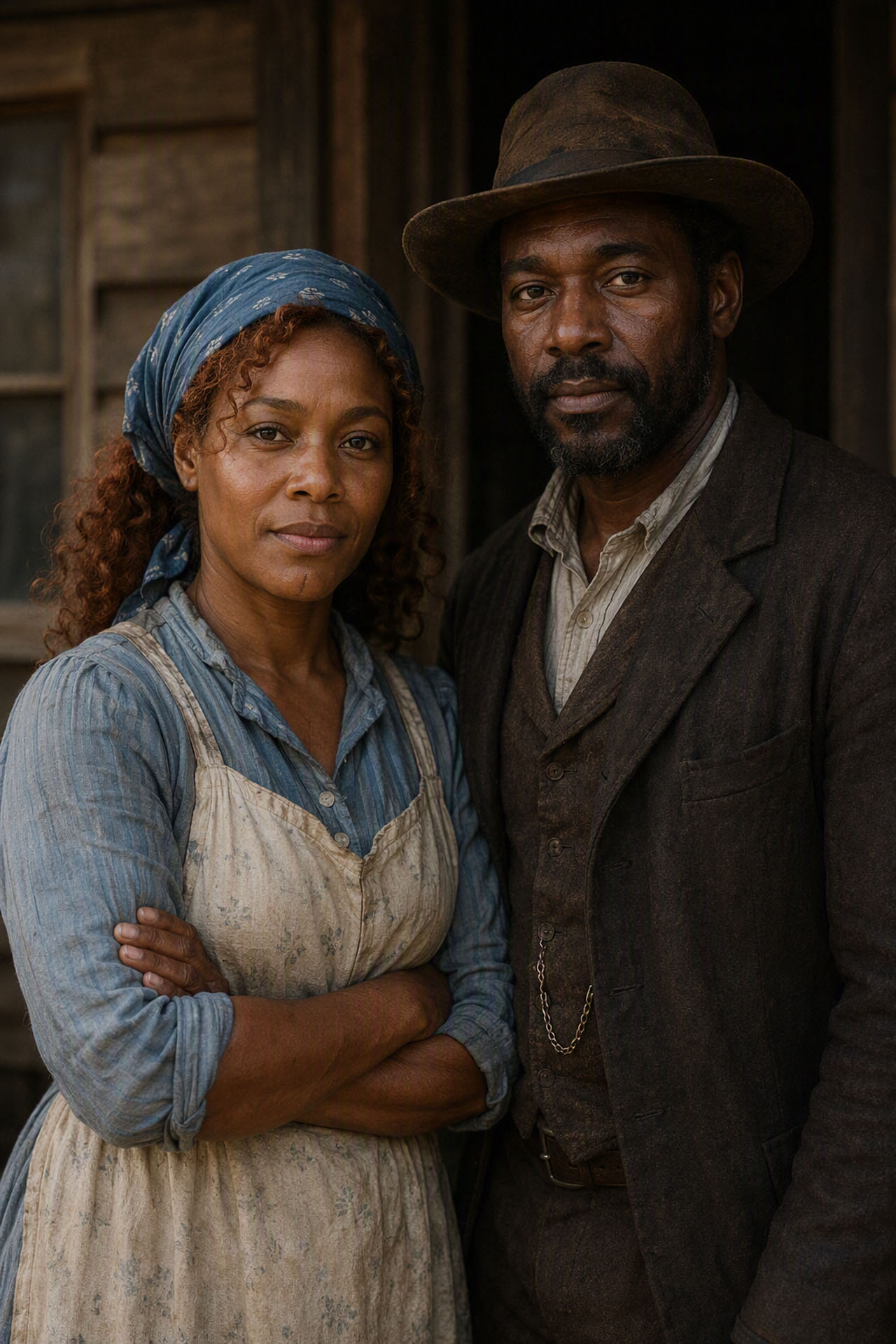
He was tall and narrow through the hips, with dark umber skin and a beard kept short and neat, the way a man keeps it when he has decided nobody will call him careless. He favored his left leg. Geneva noticed. She noticed everything that came up that road.
He took off his hat at the foot of the steps. "I need a room. I work honest. I pay on time."
His voice was deep and unhurried, every word set down like a nail driven straight. His eyes were gray-brown and calm as stones under water. He did not look away, and he did not try to fill the quiet. Most men did.
"Keep to yourself," she said. "Don't bring trouble through my door. And wash before supper."
"Yes, ma'am."
She gave him the smallest room, off the kitchen, because it was the only one empty. He signed her register with an X, and she wrote the name beside it for him: Pete Dotson. He thanked her for the room as though she had given him the best.
What she learned about him, she learned slowly, mostly from what he did not say. He had been born on a rice plantation in South Carolina and sold away from his mother at six; he remembered her hands and nothing else. When the war came he ran to the Union lines and put on the blue, and a rebel ball took him in the thigh at a river crossing he would not name. Afterward he walked county to county asking after his mother for four years, until the asking wore through. Then he went west, because west was the only direction with room in it for a man to breathe.
He signed on at the Lucky Cairn with Paul's crew, came home gray with rock dust, and washed at the pump before supper without being reminded. Evenings he sat on the back step whittling cedar until the light went. Around the house, things began to go right. The squealing pump handle went quiet. The kitchen door that stuck swung true. When Geneva asked at supper who had been at her pump, every man looked at his plate except Pete, who looked at her and said nothing.
She did not know what to make of a man who would rather fix a thing than ask for one. She had known plenty of men who wanted something from her. She did not trust one who seemed to want nothing. But Paul trusted him, and Paul trusted almost no one, and that counted for something.
One winter night she came down for water and found him in the dark kitchen, rubbing his bad thigh with the heel of his hand, his jaw tight. He stood up too fast, and the leg nearly went out from under him.
"Cold gets in it," he said. "It's nothing."
There was a tin of rose balm on the shelf behind him. She did not reach for it, and he did not look at it. He went back to his room with his hand on the wall.
In March a dust storm blew for two days and left a whole section of the yard fence flat in the creosote. Geneva went out with a hammer and a coffee can of bent nails. She had built that fence herself, and she meant to stand it up again herself. She was wrestling the first rail into place when Pete came around the side of the house, took the other end, and lifted.
"I said leave it."
She had not said it before. They both knew that. She meant it for more than the fence.
Pete set the rail down in the dirt, gently, as if it might break, and stepped back.
"Ain't trying to fix you," he said. "Just the fence."
Then he went back into the house.
She worked alone until dark and set two posts before the third split under her hammer. That night she lay awake thinking about the way he had set the rail down.
In the morning she found him at the pump. "I'll buy the posts," she said. "Cedar, not that pine they sell in town. You give the labor, and I pay you in suppers. And it's my fence."
Pete considered it as if it deserved the time. "Your fence," he agreed.
They built it on Sunday. She held each post plumb while he tamped the earth, and they spoke perhaps ten words all afternoon. He never once corrected the way she held a post, though she was fairly sure she held some of them wrong.
That night she set a tin of rose balm beside his lamp. In the morning it was back on the kitchen shelf, unopened. That evening she found him alone on the back step and held it out to him.
"My mother made this for people who work," she said. "It isn't charity. I make it in batches of twelve, and I'll be insulted if it goes to waste."
Pete looked at the tin like a man handed something heavier than it was. "Yes, ma'am," he said quietly.
He kept it. The next morning there was a second shelf in the pantry, cedar, fitted so neatly into the corner it looked as if it had always been there. Geneva put her mother's remedy book on it, and that was where the book lived as long as they stayed in that house.
That was how they spoke, those two. In shelves and tins and fences.
Samuel was slower to come around. He was sixteen, and he had been the only man in his mother's life for as long as he could remember. For weeks he watched Pete whittle on the back step and pretended he was not watching. Then one evening Pete held out the knife, handle first, without looking up.
"Cut away from yourself," he said. "Always."
Samuel stood there with his hands in his pockets. Then he sat down. He cut his thumb that first night, and Pete said nothing about it, which Samuel appreciated more than he could have said. It took him three weeks to finish the whistle. It was lopsided and played one note, and he carried it in his pocket the rest of his life. It is in the drawer with the deed now, and it still plays that note.
After that Samuel was on the back step most evenings, learning to drive a nail in three strokes and measure a board twice. When he asked how a man knew he was strong, Pete thought about it before he answered.
"By what he keeps safe," he said. "Not by what he breaks."
Geneva heard that from the kitchen window, a dish towel stopped in her hands. That was happening more often than she liked: the towel stopping, her eyes going to the back step, knowing his footsteps on the porch before he reached the door. She was thirty-nine, a widow sixteen years, with a house in her own name and a tin under the floor again. She had not been looking for anything. She told herself so fairly often that spring.
After the fence, they began to talk. It happened late, in the kitchen, after the boarders went up. Geneva sat with her ledger, and Pete came in for a dipper of water and did not go out again. They talked about the house first: the leak over room six, the Irishman in room four who was never going to pay. Then, a little at a time, about other things.
One night she found him at the table with her mother's book open, running a thick finger under a line of writing, his lips moving. He closed it carefully when he heard her.
"I wasn't hurting it."
"I know." She sat down across from him. "Can you read it?"
"No, ma'am. Never had the chance. After the war I was too busy asking people things." He looked at the book. "I always wanted to know what folks were saying about me on paper."
"I'll teach you."
She watched him start to refuse: a lifetime of not owing anybody, of being useful so he would never have to be needy. She waited.
"I can pay you for it."
"You'll pay me by learning it. I don't teach slow."
So every night that summer they sat with a slate and the remedy book, the only book in the house besides her Bible, and she taught him his letters from her mother's handwriting. The first word he read on his own was yarrow. The first word he wrote without being told was Geneva, before his own name. She wiped the slate clean and told him the G was crooked. It was not.
He told her about his mother's hands, the only thing of her he remembered: long fingers, a burn scar across one knuckle, the way she had pressed them flat against his back when he could not sleep. Geneva told him about her own mother, who had kept that book hidden in a flour sack for twenty years. She told him about Samuel's father.
"What was he like?"
"Young," she said finally. "We both were."
Pete nodded as though that were a whole answer. She supposed it was.
Toby noticed before anyone. "That man," she said one Monday, pinning saloon shirts to the line, "looks at you like you hung the moon."
"He looks at me like I hung the laundry," Geneva said, "which I did. Hand me those pins." Toby laughed so hard she had to sit down on the basket.
Lum Kee was teaching Samuel to make bread that summer, which mostly meant teaching him what he was doing wrong. "Too much flour," he would say, before Samuel had touched the flour. "Boss buys cheap flour, so you knead it longer." Geneva, at her ledger, would say she bought the flour she could afford, and Lum Kee would say that was exactly what he meant, and Samuel kneaded with his head down, grinning, while the two of them went at it over him. By August his loaves came out high enough that Lum Kee stopped criticizing them. He did not praise them either. He only took the first slice himself, every time, and that was how Samuel knew.
On Sundays the checkers games on the porch had begun to need a judge. Mateo swore Wiley moved pieces when he looked away; Wiley swore Mateo had never once in his life looked away. One afternoon they appealed to Pete, who studied the board a long while and said he had not seen the move but would believe either of them, which satisfied neither. Mateo threw his head back and laughed and called him el juez, the judge, and from then on, whenever a game went wrong, somebody went to find the judge. Pete always came. He never once ruled for either side.
In July the foreman from the Lucky Cairn came to the door with his hat on. The company was bringing in a new crew of ten men and wanted them boarded. He named a price per man as though he were doing her a favor. Geneva did not invite him in. She asked whether the price included washing. It did not. Dinner pails for the shaft? It did not. When did the company pay? End of the month.
"Then here is what it will cost," she said, and named a figure a good deal higher, washing and dinner pails included, cash every Saturday in advance. "Or you can try the hotel on Silver Street. I hear they have three beds."
The foreman took his hat off. He came back the next morning with the first week's money in an envelope.
Pete had been in the hallway the whole time, mending a chair. "You'd have made a mean general," he said.
"I'd have made a fair one," Geneva said, and went back to her ledger. But she was pleased, and for once she let him see it.
They argued, too, and she was surprised how much she liked it. They argued about whether the pantry shelf was level; she set an egg on it to prove it was not, and when the egg sat perfectly still she said the egg was lying. They argued about cloves.
"Cloves don't belong in beans," Pete said one night, out of nowhere.
Geneva stared at him. "You've been eating my beans for nine months."
"Yes, ma'am. I was being polite."
She laughed, loud and sudden, a sound nobody in that house had ever heard her make. Every boarder went still. Pete went on eating, smiling at his plate. From the stove, Lum Kee pointed his ladle at the ceiling. "I've been telling her for two years," he said. "Nobody listens to the cook." Mateo laughed so hard he had to leave the table.
She noticed his one good shirt had worn through at the elbows. She bought a length of blue chambray, sewed him a new one at night after the ledger, and left it folded on his bed without a word. He wore it to supper the next evening. By August he no longer stood up too fast when she found him rubbing his leg, and once he even asked her for the balm. Neither of them made anything of it, which was the most anything had ever been made of it.
In August the summer storms came over the mountains. Lightning walked the ridges at night, silent from so far off, and the air smelled of rain that never reached the town. One night Geneva and Pete sat on the front porch and watched it.
"Somewhere it's raining," Pete said.
"I'd like to live someplace it rains," Geneva said. She had never said it to anyone. "Really rains. So a body doesn't have to pay for water."
Pete did not laugh. After a while he reached over and took her hand, carefully, the way he had set down the fence rail, giving her time to take it back.
She did not take it back. They sat that way until the storm burned out over the mountains.
By fall she knew. She did not yet know what she was going to do about it.
He asked her in October, a year almost to the day after he had walked up the road.
It was late, the house settled into its night sounds. Geneva was at the stove stirring down the morning's bread starter with her mother's iron spoon. Pete came in from the back step and stood by the table with his hat in his hands.
She knew before he spoke.
"Geneva."
He had never called her anything but ma'am. She turned around.
"I'd like to marry you," he said. "If you'll have me." He went on carefully, as if he had practiced it on the back step. "I don't want your house. I don't want your tin. I want to sit at your table and be the one you tell things to. That's all I want."
She was holding the spoon so hard her knuckles had gone pale. She thought of her mother under the peach tree, and a letter in a stranger's hand, and fourteen years of coins, and the clerk asking whose name should go on the deed. She thought of how badly she wanted to say yes, and that frightened her more than anything in the room.
"Not yet," she said.
Pete looked at her. She saw it land. She saw him decide what to do with it.
"Then not yet," he said.
He hung his hat on the hook by the door and went to bed.
Geneva sat down at the kitchen table and did not get up for an hour. She expected to cry and did not. She expected to feel safe, and she did not feel that either.
In the morning the cupboard door that had hung crooked all summer was hanging straight, and Pete was at the table with his coffee, the same as any morning. He did not sulk, and he did not court her harder. He did not stop, either. Geneva put two eggs on his plate that Sunday, Paul's eggs. Nobody said a word about it, and everybody noticed.
Rebecca had put her pencil down long ago. "Why'd she say no? She liked him. You can tell."
"She didn't say no," Iona said. "She said not yet."
"That's the same thing."
"It isn't," I said. "In those days, when a woman married, a lot of what she owned could become her husband's in the eyes of the law. Her house. Her money."
"But Pete said he didn't want the house."
"He did. And she believed him, I think. But believing a man and betting everything you have on him are two different things." I set the spoon down. "Loving somebody doesn't mean you owe them a yes. She was waiting to see if she could be married and still be herself. Nobody had ever shown her that was possible."
The trouble had been coming since the day she signed the deed.
It was never really about the company money, though that was what set it off. What some men in Tombstone could not stand was the sight of that house: a Black woman with her own name on a deed, doing better every month, and at her table Mexican teamsters and Irish laborers, a Chinese cook, a Native man, a white Southerner, and a Black Union veteran passing the cornbread like family. Because that was what they had become. They argued and teased and nursed each other through fevers. A house like that said the old order was finished, and there were men who meant to prove it was not.
Toby brought the talk home with the saloon shirts. "There's a bunch new in town since spring," she said over the washtub. "Came out from Georgia. They drink together in the back of the Golden Lantern and talk about the old days. About riding at night. One of them keeps a white hood in his saddlebag. I've seen it."
"Lots of men talk," Geneva said.
"Not like this." Toby's face had gone red, and she would not look up. "They call you that nigger woman at the end of town. Those are their words, Geneva, not mine. They say your house is an insult to every white man in Tombstone. Micks and greasers and a Chinaman eating at a nigger's table like they was all the same as decent folk. And Wiley Hatch worst of all, a white man who ought to know better. They say somebody ought to put you all back in your places, and they say it like they mean to be the ones."
The note came under the door a week later. Samuel found it when he came down to fire the stove, and he brought it to his mother instead of burning it, because she had raised him not to hide things from her. It was printed in pencil, in capitals pressed through the paper:
NIGGER WOMAN YOU GOT ABOVE YOURSELF. YOU AND YOUR HOUSE OF MONGRELS. THIS AINT GEORGIA BUT WE AINT FORGOT HOW ITS DONE BACK HOME. GET OUT OR BURN.
Geneva read it twice and folded it into the back of her ledger.
"Are you going to the marshal?" Samuel asked.
"I am," she said. "So he knows I did."
The marshal read the note, handed it back, and said there was nothing he could do about paper. She had expected that. She had wanted it written down somewhere that she had asked.
At supper she told the house all of it. She said anyone who wanted a safer bed would have his rent back in full, tonight, no hard feelings, and she set the cash box on the table and opened it.
Nobody moved. Then Lum Kee got up, fetched the pot of beans, and began serving seconds as though she had said nothing at all. Mateo said something in Spanish that made the teamsters nod, and Wiley, who had once refused to sit at a table with him, said, "What he said."
Paul set down his fork. "This is my house," he said, looking at every face the way he looked at a road before he drove it. "Our house."
Geneva closed the cash box. She had to sit down to do it.
Two nights later someone painted NIGGER HOUSE across the cedar fence in red letters two feet high.
Geneva saw it before sunrise. She woke no one. She filled a bucket with lye water and went out alone and started on the first letter. The oil paint had soaked into the cedar, and her knuckles were raw before she finished the N. Somewhere behind her the back door opened and shut.
Pete came across the yard with a second bucket and stopped at the end of the fence. "Your fence," he said. It was a question.
Geneva moved her bucket over to make room.
They scrubbed side by side. After a while Samuel came out and knelt at the bottom of the letters, where the paint had run. Then Paul. Then Toby with her washboard, which worked better than any brush. Then Mateo and the teamsters, Wiley, the Irishmen, and two company men who had never said ten words to Geneva. Lum Kee kept every bucket filled with hot water. The women from the locked room came out in their shawls, and one of them, who had never spoken above a whisper, began a church song. After the first verse Geneva sang it with her.
By full sunup there were twenty people along that fence, every color God made, scrubbing and singing. Miners on their way to the shift stopped in the road to stare. Outside the Golden Lantern, three men watched with their arms folded, and they did not laugh.
When the last letter was gone, the cedar had scrubbed pale in a long stripe the length of the fence. Geneva never painted over it. She wanted people to see where it had been, and what it had taken to get it off.
A week later Samuel found a cactus wren on the front step, its neck wrung and its wings spread flat on purpose. He buried it behind the garden before his mother could see. Pete saw. He stood beside the boy and said nothing until Samuel stopped shaking.
That night, for the first time, Geneva took the rock away and shut the front door. She did not lock it; she would not give them that. Most of the company crew moved up to the Lucky Cairn bunkhouse within the week. Two of them stayed. Paul and those two took turns sitting up in the front room with a shotgun, and the teamsters pulled their wagons into the yard at night, nose to tail. Geneva watched her house rearrange itself to protect her, and she did not like how much she needed it.
The fire came in November, in the shed behind the kitchen. Pete smelled the smoke first. He was out the back door in his stocking feet, dragging burning boards out with his bare hands before anyone could hand him a bucket, because the water barrels were stacked against the shed's back wall, and if they burned the house had no water. He got them out. By the time the sky went gray, the shed was a black ruin and the house still stood.
Pete sat down on the back step. His palms were blistered white.
Geneva knelt in the dirt and dressed his hands with clean cloth and the rose balm while the bucket line stood around them, gray-faced. Pete did not pull away. He did not say he was fine. He let her.
"You could have lost these hands," she said. Her voice was not steady.
"Could've lost the water."
"I'd rather lose the water. Do you hear me? I would rather lose the water."
"Yes, ma'am," he said, softly, and not the way he had said it before.
Later Samuel found her alone in the pantry with her hands flat on the cedar shelf. "Are you scared?" he asked. He had never asked her that.
She thought about lying to him, but she had raised him not to lie. "Yes," she said. "Courage isn't the same as not being scared, baby. Courage is deciding what to do while fear is telling you the truth."
They came in January, three nights after the new year, an hour after moonrise.
Paul was on watch, and by the time the torches came around the bend he had the house awake. Geneva came down in her nightdress with a shawl over it and her mother's blue kerchief tied over her hair. She had the iron spoon in her hand, because it was the first thing she had touched in the dark, and she did not put it down all night.
There were eleven of them in white hoods, sitting their horses in a half circle in front of the pale stripe on the fence. Two carried torches. One had a coil of rope over his saddle horn, and he made sure the house could see it.
"Nigger woman!" The voice had Georgia in it, thick as red clay. "Come on out. You and that buck you keep in the back. Send out your mongrels too. We'll sort them."
Pete went out onto the porch. His hands were still bound in cloth from the fire, and he held the Springfield he had carried home from the war. He stood at the top of the steps in his blue chambray shirt and did not raise the gun. He did not have to.
"There's a woman and a boy in this house," he said, "and a dozen people who pay their rent and mind their business. Y'all go home."
"Look at that. Nigger thinks he's still wearing the blue."
"I am wearing blue," Pete said.
The torch-bearer on the left spurred toward the porch, torch held back to throw. Pete fired once. The shot took the torch out of the man's hand, and his horse went up and threw him in the road.
In the silence after that, the lamps came on. One window, then another, then every window in the house, and behind every lamp a face, and behind half the faces a gun. Mateo at the upstairs window. Paul in the front doorway with his shotgun. Lum Kee in the kitchen door with a meat cleaver, because it was what he had. The house that had been dark a minute before was lit up like a church on Christmas Eve.
"You picked the wrong house," Pete said.
The man in the middle sat still, counting windows. Then he turned his horse. "This ain't over, nigger. We'll be back with enough rope for all of you." They rode off toward town, and the torches went small and then went out.
Nobody went back to bed. An hour later Toby came running up the road in her shawl and nightgown. She slept behind the Golden Lantern's wash shed, and the riders had come in loud, and the wall was thin.
"They're coming back at first light," she said. "Thirty, maybe. They've sent to the canyon camps. They mean to burn it with you inside."
The clock said ten past one. First light was a little after six.
"We can run," Pete said quietly. "Tonight, while they're drinking."
Paul had come in behind Toby, his boots white with dust; he had followed the riders partway to town. "The north road is watched," he said. "Two men and a fire, down by the wash. The town road runs past the Lantern." He counted on his fingers, the way he counted ore cars. "The wagons in the yard have no teams. The mules are at the freight corral in town, across the street from where the riders are drinking. The mine's teams are in the company yard out by the old ore road, but the yard is locked until the shift at seven. And nobody has used that ore road in two years. I have to ride it first, in the dark. If it's washed out, we'd be on it with no way back."
"I can hide the three women from the locked room at the church," Toby said. "But I can't hide seventeen people, Geneva. Not in this town."
Geneva put her hand flat on the table. "Then we stay until Paul has a way out. This house has walls, and water in the barrels, and a dozen people who can shoot. On an open road in the dark, we have nothing. Here we can hold."
"It's your house, Doña," Mateo said from the doorway. "You say."
"Our house," Lum Kee said from the stove, without turning around.
Geneva looked at Pete. He waited, the way he had waited at the end of the fence. It was her house and her choice. He would not make it for her.
"Anybody who wants to go, go now," she said, "and nobody here will think less of you." Nobody moved. "Samuel goes with Toby."
"No, ma'am." Samuel's voice cracked, and he said it again so it would not. "I'm seventeen. You raised me in this house."
She looked at her son a long time. "Then you'll load for Pete. And you'll stay off that porch."
Paul was already pulling his coat on. "I'll ride the ore road first. Then I'll wait at the yard for the gate. Hold until I come." He went out into the dark.
Geneva put the spoon in her apron pocket. "We stand," she said. "Until Paul comes."
They had four hours, and nobody wasted one.
At two o'clock Toby took the three women from the locked room out the back gate by starlight, to the little church on the south side. The men stood mattresses against the windows. The teamsters pulled their wagons across the yard and filled the beds with flour sacks and sand. Lum Kee filled every pot and washtub in the house with water and lined them down the hallway like soldiers. Samuel sorted every cartridge in the house by caliber, his hands steady because he made them be.
Pete put people where they belonged: Mateo and Wiley at the upstairs windows, the Irishmen in the kitchen, the teamsters behind the wagons, himself on the porch behind the overturned dining table. Geneva placed herself in the front hall with a shotgun across her knees, where she could see every room.
Upstairs in the dark, Mateo sang under his breath, a slow song about a river. After a while Wiley told him to hush. A while after that, Wiley asked him to keep going.
At four o'clock Geneva went out to the porch. Pete sat behind the overturned table with his back to the wall and his bandaged hands open on his knees. She knelt, unwound the old cloth, and wrapped clean strips tight across his palms so he could close his hands around the rifle. Neither of them said anything while she worked. When she was done, he closed his hands, opened them, and closed them again.
"That'll hold," he said.
"It had better," Geneva said, and went back to the hall.
They came at a quarter to six with the gray light behind them. Samuel counted thirty-one.
"Last chance, niggers!" the man in the middle shouted. "Send out the woman and that buck, and the rest of you mongrels can crawl off home!"
Nobody answered. Then they came all at once.
Grandma Geneva never told this part the same way twice, and never for long. What she told was the noise, and the glass coming in, and horses screaming, and rifle smoke so thick in the hall she could not see the front door. Pete firing from behind the table, slow and steady, the way he did everything. The teamsters behind their wagons, holding. Riders falling in the road, one and then another, until she lost count.
A torch came over and caught on the porch roof below the upstairs windows. Mateo leaned out to knock it off with his rifle butt. He had nearly done it when the shot took him. He fell back into the room, and Wiley caught him.
At the back, six of them came over the garden fence on foot and broke the kitchen door off its hinges. Lum Kee was standing between that door and the hallway, and at the end of the hallway was Samuel, on his knees with the cartridge boxes. Lum Kee fired both barrels of a shotgun, and when it was empty he picked up the cleaver. He held that doorway until Pete and the Irishmen came through the house. He held it long enough. That was all anyone ever said about it, and it was enough.
When the sun cleared the ridge, the riders broke and went back toward town at a gallop, carrying their wounded across their saddles. Seven of them stayed behind in the road and the yard, and one in Geneva's kitchen with his hood half torn off, younger than Samuel.
By then the house was burning. The porch roof had caught, and the shed, and the fire had climbed the north wall while everyone fought. They threw every pot Lum Kee had filled. The teamsters worked the pump until the handle broke. Geneva stood in the hall with smoke coming down the stairs and understood it was not going to be enough.
"Let it go," she said. Then louder, so they would hear her. "Let it go! Everybody out!"
They carried Mateo and Lum Kee out first.
Geneva was the last out of the front hall. At the door she looked back once toward the kitchen. The pantry doorway was full of fire. Somewhere in it was the cedar shelf, and on the shelf her mother's book. Smoke was coming down the stairs, and somewhere in it Pete was shouting for Samuel. She thought Mama's book, and then there was no more room to think about it, and she went out. The deed was buttoned inside her dress. The spoon was in her pocket.
They stood in the road and watched the house burn to the ground. By eight o'clock nothing was left but the stone chimney, standing up out of the ashes by itself.
Nobody could believe it. That was what Grandma Geneva remembered most. Wiley sat in the dirt with Mateo's head in his lap, saying the same thing over and over: He was just singing. He was just singing. Samuel kept looking at where the kitchen had been, as if Lum Kee might walk out of the smoke and complain about the bread.
Geneva knelt beside Lum Kee and closed his eyes. She folded the towel he had always kept over his shoulder and laid it on his chest.
"Thank you, Lum Kee," she said. "Thank you for my boy."
There was no time for coffins. The riders had gone back to town with their wounded and their dead to count, and nobody knew how long that would hold them.
Wiley and the teamsters dug two graves at the end of the garden, beside the collards, while the ashes still smoked. It took most of an hour. They buried Mateo with his guitar across his chest and Lum Kee with his knives wrapped in a clean towel. Geneva stood at the head of the graves. Her Bible had burned, so she said their names instead, all of them, every one she knew. Then she said the last of her four rules, because it was the truest thing she had.
"Nobody leaves this house hungry, dirty, or ashamed. You two never once let anybody leave hungry."
Wiley took Mateo's hat. He said he would carry it south to Mateo's mother himself and tell her how her son had died, and he would not let anybody else do it.
Before he went, Wiley stood in front of Geneva with the hat in both hands. "When I came here," he said, "I wouldn't sit at your table."
"I remember."
"I want you to know I'm ashamed of that."
"I know you are," Geneva said. "Go on, now. His mother's waiting."
Toby came back a little after nine on a borrowed horse. She saw the chimney, then the two fresh graves, and she had to hold on to the saddle horn. When she could talk, she told them what the town was saying: seven white men murdered by a nigger house full of greasers and Chinamen. Nobody was saying who had ridden out there in hoods with rope. The marshal was swearing in a posse, half of it men who had been on that road at dawn, and he would have them mounted by noon.
"They'll hang Pete," Toby said. "And Samuel. And every man here who fired a gun. They won't wait for a judge."
So the house scattered. The teamsters slipped into town for their mules while the riders were still nursing their wounded, and drove south toward the border with Wiley among them. The Irishmen went up the canyon to the camps. The two company men walked back to the bunkhouse and swore they had been asleep all night. Some of them held Geneva before they went. Some could only touch her shoulder and not look at her, and she understood that too.
Paul came up the back way soon after with a mule team and a company freight wagon. Nobody ever asked how a mucker came to drive it out of the yard, and Paul never said.
"The ore road is clear," he said. "I rode it twice in the dark. It's bad, but it goes around."
Toby was already turning her horse. "I'm going to the marshal, crying. I'll tell him I saw you all light out south on the border road the minute the shooting stopped. His posse will ride south all day."
"You know what they'll do to you if they figure it out."
"They won't. They think a washerwoman can't count past her own fingers." Toby leaned down from the saddle and held Geneva, awkwardly, for as long as she dared. Then she wiped her eyes and rode for town.
There was hardly anything to load: the tobacco tin, which Samuel had dug out of the ashes black but whole; Pete's rifle; Samuel's whistle; a sack of bread, a blanket, a skillet, and a tin cup the boarders had pressed on them. The battle had torn the burns on Pete's hands wide open, and they bled through the bandages, so Samuel took the reins. He had turned seventeen that week and had never driven a team in his life. Paul sat beside him and talked him through it: easy on the left, give them their heads on the grade, trust the mules, they see better than you.
The ore road was rutted and steep and wound up into hills where nobody had reason to be. From the first switchback they could see the two men at the wash on the north road, sitting by their fire, facing the wrong way.
At the top of the grade, where the ore road met the old stage road north, Paul climbed down. He had to be underground by the noon shift, where the shift boss would see him. He reached into his coat and set something in Geneva's hand. Two eggs.
She laughed. Then she was crying, for the first time since the shooting started, and she could not stop. Paul patted her shoulder twice, very gently, the way he might steady a mule.
"It's still our house," he said. "Somewhere."
Then he walked back down the road alone.
From the next ridge they could see back to Tombstone, a thin gray line of smoke going straight up from the end of town, and the chimney. Samuel stopped the team. Nobody told him to. Geneva stood up in the wagon and looked back a long time, and Pete stood beside her without touching her or saying anything until she was done looking.
When she sat down, she put her hand on the front of her dress, over the deed. It was the deed to a burned lot and a chimney and two graves. It was still hers.
"Drive on, baby," she told Samuel. "North."
Iona had come around the table to lean against my arm.
"That's not fair," Rebecca said. Her voice had gone flat, the way children's voices go when something is too big to be angry about. "They got away. But Mateo was just singing."
I took the pot off the heat. The balm was ready to pour. I did not pour it yet.
"It wasn't fair," I said. "Getting away didn't bring anybody back, and Grandma Geneva never pretended it did. She said their names every Sunday for the rest of her life, right after grace. I grew up hearing them. I thought they were family before I knew who they were."
"They were family," Iona said.
"Yes," I said. "That's exactly what they were."
Rebecca was quiet. Then she asked, "What happened to Toby?"
"Toby has her own piece of this," I said. "But I have to get them north first."
The first night they camped in a dry wash with a fire no bigger than a hat, banked low so it could not be seen from the road. Samuel cooked the beans before they were soft and burned the bottoms, and then he sat with the spoon in his hand, not eating. Geneva knew what he was waiting for: somebody at the stove to tell him what he had done wrong.
Nobody did. That was the worst of it.
Later, too cold to sleep, Samuel blew his whistle once, very softly, its one lopsided note. At home on a night like that there would have been a guitar on the porch and somebody singing about a river. Samuel put the whistle away and did not take it out again for a long time.
In Tucson a Black family who kept a livery took them in without asking more than their names. Geneva never told anyone that family's name, because she had promised not to. The livery man saw to Paul's wagon and drove them to the railway in his own buggy, Pete lying under feed sacks, and Geneva counted the fares out of the tobacco tin one coin at a time. They rode the cars west to the coast and went north by steamer, third class, below the waterline.
The night before the train, the livery man's wife fed them at her own table and would not take a cent. Samuel ate three plates. It was the first meal since Tombstone that anybody had cooked right, and halfway through the second plate he began to cry without making a sound. The woman filled his plate again and did not look at him, and Geneva loved her for it the rest of her life.
Pete's hands would not heal. When the last of the balm in her apron tin ran out, Geneva tried to remember what her mother had used for burns that went bad. It was on a page near the back of the book, in her mother's slanting hand. She could see the ink blot in the corner and the word comfrey underlined twice. She could not see the amounts. She lay awake in the dark of the steamer trying to read a page that was not there. She did not say anything about it to anyone. She made a poultice from what she could buy and what she could remember, and slowly Pete's hands began to close.
On the fourth day the steamer turned into a long gray sound between dark hills, and it began to rain.
It was not desert rain, the kind that threatens for days and gives nothing. It came down soft and cold and steady, as though it had been raining there forever. Samuel went up on the open deck and stood at the rail with his face turned up, and his shirt went dark to the skin, and he began to laugh. It was the first time since the shooting any of them had heard him laugh at all.
Geneva came up behind him and held out her hand, palm up, and let the rain fill it. Pete stood beside her with his wrapped hands held out in the rain too.
"Somewhere it's raining," he said.
She looked at him. She had told him once, on a porch, that she wanted to live someplace it rained. She had not thought he would remember.
"Here," Geneva said. "It's raining here."
Seattle came up out of the gray: wet roofs climbing a hill, smoke from a hundred chimneys, and behind it all, when the clouds tore open, a white mountain standing over everything like it was keeping watch.
They took two rooms at the top of a rooming house on a street so steep the wagons went up it sideways. It rained on the roof all night the first night, and Geneva lay awake listening to it. It was the best sound she had ever heard.
In the morning they unpacked, which took five minutes. The tobacco tin went under a loose board. The spoon went on the windowsill. Samuel's whistle went on the nail by the door. Pete unbuckled his canvas bag, took out a bundle wrapped in the oilcloth from his rifle, unwrapped it, and set it beside her elbow the way he might have set down a cup of coffee.
It was her mother's book.
The corner of the cover was scorched black, and the pages along one edge had gone brown with heat. But it was the book, with the flour-sack stain on the back and the ink blot near the end, and Geneva could not move.
Pete was already turning back to his bag. Then he saw her face.
"I took it off the shelf when the kitchen caught," he said slowly. "Before I went for Samuel. I thought you knew."
"I thought it burned."
Pete sat down across from her, looking like a man who had just been told he had walked a thousand miles on a broken leg. "All this way? You thought that all this way?"
She nodded. She could not speak.
"I'd have told you," he said. "The first night."
"I know you would."
She turned to the page with comfrey underlined twice, and the amounts were there, exactly where they had always been. That was when Geneva cried. Not for long, but it went past the book, for the house and the long table, for Mateo at the upstairs window and Lum Kee in the kitchen door, for every coin she had ever counted into that tin. Pete came around the table and put his healing hand flat against her back, the way his mother had once done for him.
Grandma Geneva always said the book was the one thing out of that fire she had not expected. It did not bring anybody back, or one board of that house. But it was her mother's hand, and it had come through the fire, and some days that was enough to stand on.
They went to work. Pete found carpentry on the waterfront as soon as his hands would hold a hammer. Geneva took in washing and sold her mother's balm at the Saturday market for ten cents a tin, then fifteen, because she had always known what a thing was worth. Samuel came home from the sawmill smelling of fir. They started a second tin under the loose board, and Pete put his wages in it every Saturday.
On Saturday mornings Geneva set a plank across two crates under the dripping eaves of the market and laid out her tins in rows. The first week she sold four. The fourth week a woman came back for six and brought her sister. By winter people asked for her by name.
In the fall Geneva began walking home past a gray house on a corner that had stood empty since spring. It had a porch and a big kitchen. One night she wrote her arithmetic on the back of a laundry ticket and slid it across the table. Pete read it twice, slowly, the way she had taught him.
"Eight rooms," he said.
"Paid off in four years, if we're careful."
He set the ticket down and was quiet long enough that she felt the old cold settle in her stomach.
"I want to tell you something," he said, "and I want you to hear the whole of it before you decide. I'm forty-two. I've slept in other people's houses my whole life. I'd like a door I can shut. One room where nobody's trouble comes through but ours. I'd like to sit on a porch someday and not be on watch." He looked at the ticket. "I know what that house means to you. I'm not asking you to be anything less. But eight rooms of strangers every night again, Geneva. I don't know if I have that in me. I'm tired."
She was angry. She admitted that to me years later, when she was old enough to laugh about it. She was angry for a whole day, because it felt like somebody reaching for her fence, and she scrubbed a week of other people's shirts harder than they needed. Then, late the next night, she sat down across from him with a fresh ticket.
"Four rooms to let," she said. "Not eight. Two rooms upstairs at the back for us, with a door that locks, and nobody comes through it but family. Supper on Sundays for anybody who needs it, the way it was. The rest of the week, the porch is yours."
Pete read it. "Four."
"Four."
"In whose name?"
"Both of ours," Geneva said. "Because I'm choosing it."
Something in his face let go that had been held tight as long as she had known him.
Toby's letter came that winter, in a hand that had clearly had help with the spelling. The marshal had believed every word and ridden south two days for nothing but sunburn. Paul sent his best and two eggs, which would not survive the post and so were included in spirit. Toby had planted collards over the graves. The chimney still stood, and nobody had built on the lot, because nobody wanted to. She was not sorry for one thing she had done. Geneva read it three times and put it in the back of her mother's book, behind the comfrey page.
That evening she found Pete on the back step, watching the rain fill a row of empty balm jars she had set out to rinse. The jars rang softly, each a different note. She sat down beside him.
"Ask me again," she said.
Pete turned and looked at her. He did not smile right away. He made sure first.
"Geneva," he said. "Will you marry me?"
"Yes," she said. "But you are still washing before supper."
They were married in the spring, in a church on the south side with a borrowed piano and fourteen people in the pews. Geneva wore her mother's blue kerchief. After the vows she stood up in front of everybody and said two names, Mateo Ruiz and Lum Kee, so that they would be there too.
It took two more years to buy the gray house on the corner. They opened it in the spring of 1884 with four rooms to let, a sign Pete lettered himself, and a rock to prop the front door.
They were not saints, those two. They argued about money and whether the porch rail was level, and about cloves for twenty years. Pete never did learn to like the beans. He ate them every Sunday anyway, and every Sunday he said so. On Sundays the table filled with boarders and neighbors and whoever came to the back door hungry, and after grace Geneva said two names. New boarders looked confused the first week. By the second they bowed their heads too. Some Sundays there were twenty at the table again, and for an hour the gray house sounded almost like the one at the end of Tombstone, but for the guitar. The rest of the week the porch was Pete's, and he sat out there with his cedar and the rain coming off the eave, and he was not on watch.
Samuel married a girl from the church with the borrowed piano. They had a hard time having children, and then late, when nobody expected it anymore, they had me. Pete did not live to see it. He died in the fall of 1905 in his chair on the porch, cedar shavings in his lap and the rain coming down soft. Geneva found him there when she brought out his coffee. Pete was not my father's father by blood. But my father always said Pete was his father in every way that leaves a mark, and he would show you the marks: a nail driven straight in three strokes, a blade kept sharp, a board measured twice. When he taught me to whittle on that same porch, the first thing he told me was cut away from yourself, always, in a voice I understood, years later, was not quite his own.
After Pete died, Geneva said three names on Sundays.
I learned the balm from her when I was seven, in the kitchen of the gray house. She was past seventy and her hands shook, so I did the stirring while she told me the amounts out of her head. "Slow," she would say. "The beeswax doesn't care how busy you are." The book lay open on the counter. She never once looked at it. I think she kept it open just to have her mother's handwriting in the room.
I asked her once what the balm was for. I meant burns, or chapped hands.
"It's for remembering what tenderness survived," she said.
She died the winter I turned seventeen. The kerchief went to my father, the book went to me, and the spoon went to whoever was standing at the stove, which turned out to be me.
The balm had cooled enough to pour. I filled the first jar, and the kitchen went sweet with roses and warm wax and the green note underneath that you do not notice until it is gone. Iona dipped one finger into the top of the jar, the way I once had at Grandma Geneva's elbow. I let her.
Rebecca watched the jar fill. "So they made it," she said. "In the end."
I thought about a peach tree, and a chimney standing alone in the ashes, and two graves under the collards, and a gray house with a rock by the door.
"They made a life," I said. "That's different from reaching the end of a story."
She frowned at that. I hoped she would keep frowning at it for years. That is how a story like that gets carried.
Iona rubbed the balm into the back of her hand. "What do I tell people when they ask what it's for?"
I set down the iron spoon.
"Tell them we were here," I said. "Tell them we endured. Tell them we made room. And tell them we passed it on."
Outside, the rain began again, soft at first and then settling in, the way it does in Seattle when it means to stay the night.
I reached for another jar, and I poured.