
(
0
)
Your bag


Your bag is waiting for something special.
Start Shopping
Product is not available in this quantity.



Elara knew the ceiling of her cottage better than her own face.
There were eleven beams. The third from the window had a knot shaped like a closed eye, and on the worst nights she envied it. She had counted the beams forward and backward. She had counted her breaths, lost the count, and begun again. Somewhere past midnight the wren under the eaves would shift and settle, and Elara would think, even the wren, and turn her face to the wall.
At first light she gave up and went to the loom.
It stood under the window where the light was best, where her mother had set it thirty years ago. The cottage had been her mother's, and her mother's mother's before that: one room and a loft, a hearth blackened by a century of fires, a garden of beans and marigolds behind, and the loom, which was the heart of it. Elara had learned to weave on that loom before she could read. She could still see her mother's hands guiding hers, patient, sure, smelling of wool grease and woodsmoke. Slow, Ela. The cloth remembers every hurry.
Her mother had died three winters ago, quietly, between one snow and the next. Elara had kept the loom going ever since. It was what she knew how to do.
She was thirty-two that spring. She was not a beauty, she would have said, though she would have been wrong. She had her father's auburn hair, which she wore in a long braid over one shoulder, strands always working loose; a scatter of freckles across her nose that darkened every summer; and gray-blue eyes that people said looked straight through them. She was tall for a woman and thin that year, too thin, her cheekbones sharp under skin that reddened in any wind. She wore plain cream linen and a gray-blue shawl she had woven herself, and she apologized more than anyone in the village, even for things that were not her fault.
She sat, took up the shuttle, and began the blue border the miller's wife had ordered. By midmorning she held the cloth to the window and saw the border wandering like a drunk down a lane, three threads off and then four.
The cloth remembers every hurry. She unpicked it row by row, and did not cry, because crying took a kind of energy she no longer had.
The letter from her sister came at noon. Maren had married a cooper and moved two villages over, and she wrote the way she talked, all in a rush: the baby's new tooth, the price of salt, a neighbor's quarrel over a fence. And at the very bottom, as always, squeezed in small:
And you, Ela? Is there anyone?
Elara put the letter on the shelf with the others. Every one of them ended with that line.
There had been someone, twice. Tomas, the summer she was twenty, who had walked out with her every evening for a season and then married the blacksmith's daughter. And Wil, years later, kind and slow-spoken, who had courted her through a whole winter and then, in the spring, simply stopped coming. Neither had been cruel. They had only, in time, looked past her toward someone else. She had been the almost in two men's stories, and she had learned what such women learn: to want quietly, to take up less room, to fold the hope away the way one folds a good shawl too fine for every day, and lay it at the bottom of the chest.
But at night the chest would not stay shut.
At the well that evening the talk was all of the sky. A peddler had come through with an almanac, and the almanac said that next spring, on the very day of the fair, the sun would go dark at noon.
"Dark as midnight," said the miller's wife, who liked a story, "in the hills to the north, anyhow. Here it'll only dim, more's the pity."
Elara drew her water and went home. A year away. She could not think past tonight.
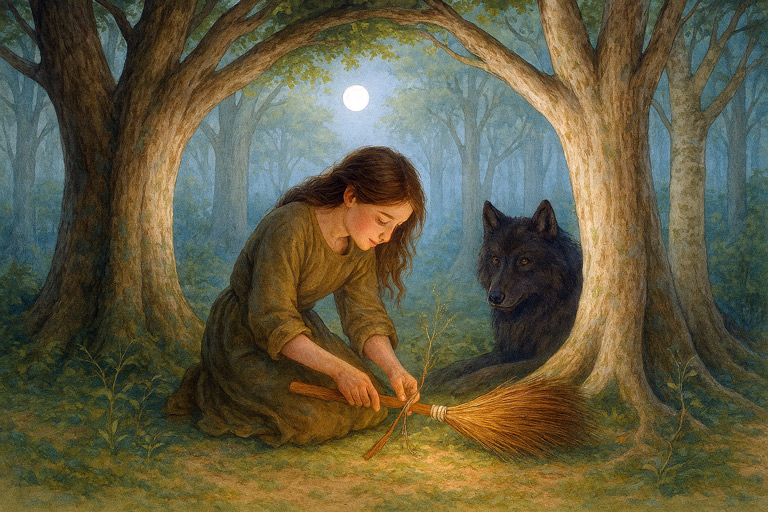
When the sleeplessness would not let go, she walked. She had done it all spring: shawl over her nightdress, boots unlaced, past the dark well and over the stile into the forest, where the path split at an old oak cleft by lightning. The left fork followed the stream in an hour's loop back to the village. It was safe and familiar, and she always took it.
The right fork went deeper into the woods. Every village child had heard the stories about where it led: a soothsayer, who could see what you needed before you knew it yourself. Elara had never believed them. She had never once gone right.
On the fourth night without sleep, standing at the split oak in the moonlight, she went right.
She could not have said why. Perhaps only because the left had stopped working. The trees closed over her, older and taller than the ones by the stream. The air turned cool and green, smelling of moss and old leaves.
Then she smelled lavender.
It came threading through the damp air, sweet and deep, warmer than the lavender in her own garden. Beneath it ran something brighter, an herb she knew but could not name. The scent pulled at her gently, the way a hand on the sleeve says this way.
She followed it around a bend, and the trees opened.
A cottage stood in a clearing of silver grass, small and round-shouldered, its roof thick with moss. Behind it, pale in the moonlight, stood a row of beehives. Gold light filled the windows, and it did not flicker the way candlelight flickers. It held steady, as if it had been lit long ago and kept burning for someone who was late.
"You might as well come in," a voice called. "The tea's poured."
The woman in the doorway looked nothing like the stories. The stories gave her a hood, a staff, eyes like lamps. This woman was perhaps fifty, short and solid, in a plain wheat-colored linen dress with the sleeves rolled to the elbow and an apron over it stained every shade of green. Her dark hair was streaked thickly with gray and twisted into a loose knot, strands falling free around a face brown from the sun and lined deep from laughing. There was a smudge of crushed herbs on her wrist. Only her eyes were as the tales described: dark brown, warm, unhurried, and faintly amused, as if most of the world struck her as a joke she was too kind to explain.
"I'm Selene," she said. "And you're Elara, the weaver's girl. Your mother made the best linen in the valley."
"You knew my mother?"
"I grew up in your village, child. Long before you were born. Come in. You're letting the warm out."
Inside, herbs hung from every beam: lavender, mugwort, yarrow, rosemary, bundles of things Elara could not name. Shelves held old books and jars of powders and dried petals, and a long worktable stood under the window, crowded with wooden molds and crocks and a basket of eggs. On the little table by the hearth stood two clay cups, both steaming.
"Two," Elara said.
"Two," Selene agreed, and sat.
The tea was chamomile and dark, wild honey. "From my bees," Selene said, though Elara had not asked.
Elara had expected to be read, or prophesied at. Instead Selene asked after the miller's wife and the marigolds her mother used to dye with, and when Elara admitted she could not sleep, Selene only nodded, as if Elara had said it might rain.
"Then come back when you can't," she said. "I'm generally up."
No remedy. No spell. Elara walked home on the right-hand path, puzzled and oddly light, and slept, for once, a little before dawn.
She went back three nights later. And then again.
By midsummer she was going two or three nights a week, whenever the beams began to blur. The path to the right became as familiar as the one to the left had been. She learned the cottage the way she had learned her mother's loom: by doing.
Selene worked at night as much as by day: soap pressed into wooden molds and wrapped in undyed cloth, salves for burns and teething gums, tinctures she did not explain. Villagers came to the cottage after dark more often than anyone would admit, and she sent each of them home with tea and something wrapped in cloth, often for nothing.
She tended the bees in the mornings, bare-handed, humming to them, low and steady, a tune that never quite resolved. She swore at her hens. She was dreadful at keeping a fire and excellent at keeping a secret. She laughed easily, a low, rough laugh, and she had opinions about everything from the vicar's sermons to the proper way to dry yarrow.
She had come to the cottage at twenty, she told Elara one night, when an old herbwoman named Wenna still lived there. "I was in a bad way. Wenna took me in and taught me everything she knew, and when she died, she left me the cottage and the bees and her bad knees." She did not say what the bad way had been. Elara did not ask.
On the windowsill among the jars sat a small carved wooden bee, smooth with handling. Once Elara asked about it.
"A gift," Selene said. "A long time ago." And she touched it, lightly, and changed the subject.
Elara began to make herself useful. She brought linen for wrapping the soap, finer than Selene's, and Selene held it to the light and said, "Your mother's hands," which made Elara's eyes sting. And slowly, without either of them remarking on it, they became friends.
Elara told her things she had never told anyone. About Tomas and Wil. About the chest at the bottom of her heart and the hope folded in it. About Maren's letters, and the line at the bottom of every one.
"And is there?" Selene asked. "Anyone?"
"No," Elara said. "And I'm tired of hoping. Hoping is the most tiring thing there is."
Selene looked at her a long moment with her dark, amused, sorrowful eyes. "No, child," she said. "Not hoping is."
The walks helped a little, and the company more. But by late summer Elara was sleeping two hours a night. She dropped a cup she did not remember holding. Her hands shook.
One night near the end of summer, she came into the clearing so tired she could barely see the light in the windows, and Selene took one look at her in the doorway and said, "Sit down before you fall down."
The tea was poured. Two cups. But this time, when Elara had drunk hers, Selene rose and went to the high shelf above her worktable, and came back with a bundle wrapped in Elara's own linen and tied with string.
"I've been waiting," Selene said, "to see if the walks and the company would be enough. They aren't. So." She set it in Elara's lap. "Open it."
Inside lay a bar of soap, pale as new cream, pressed with a design Elara had never seen Selene use: a sun and a crescent moon curved together in an embrace, the sun's rays folded around the moon's thin arms. Beside it lay a small glass bottle of oil the color of late honey, stoppered with cork, and pressed into its glass, the same small sun and moon.
The scent rose to meet her: lavender, deep and sweet, the very lavender she had followed through the trees that first night. And under it, rosemary.
"Wash with the soap at night," Selene said. "Lavender for sleep. Rosemary for waking. You don't only want to sleep, child. You want to wake up whole." She drew the cork from the bottle, and a different scent rose, lavender again but with something warm and woody beneath it. "Then a few drops of this, warmed between your palms. Wrists, throat, shoulders. There's cedar in it. Cedar's the steadiest wood there is. It doesn't bend in storms."
That was all. No spell. No prophecy. It sounded like the kind of thing her mother might have said.
"And stop counting the beams," Selene added.
Elara looked up sharply. "I never told you about the beams."
"You've told me about them every time you've come." Selene was already clearing the cups. "Go home. Sleep."
At her own basin, Elara unwrapped the soap and held it a long moment, tracing the sun and moon with her thumb. Then she washed. The lather came up thick and soft, and the scent rose with the steam, lavender first, then the rosemary, clean as a cold morning. She warmed the oil in her palms and pressed it to her wrists, her throat, her aching shoulders, and the cedar rose warm from her own skin, steady and close, like an arm around her.
She lay down. She looked at the ceiling.
She did not count the beams.
Sleep came softly, like water filling a footprint. And at the very edge of it, as the scent of lavender and cedar carried her down, she had the strangest feeling, the way one knows in a dark room that one is not alone.
Someone was there. Someone was waiting. And whoever it was smelled of cedar.
She was standing barefoot in a field, and the field was full of light.
The light came from the flowers. They grew to her knees, tall and slender, with pale cupped petals that glowed from inside like lanterns. Moonlilies, she thought, though she had never heard the word before. They stretched away on every side, swaying though there was no wind. Above them the sky was so crowded with stars that they ran together in rivers and pools.
It was night here. She had the feeling it was always night here.
Somewhere ahead she heard water: not the chatter of a stream but one long, low note, rising and falling like breathing. She walked toward it. The river, when she reached it, was wide and slow and silver, and it was singing.
On a flat stone at the water's edge sat a man with his boots off and his feet in the current.
Elara stopped dead.
He had not seen her yet. He was tall, even sitting, with dark curls falling over his brow and broad shoulders that looked used to carrying things. His shirt was rolled to the elbows. Pale curls of wood shaving clung to his forearms, as though he had come straight from a workbench, and the air around him smelled of cedar.
Then he turned his head and saw her, and nearly fell off the stone.
"God's teeth," he said, grabbing at the rock. "Where did you come from?"
"Where did I—" Elara drew her shawl tighter, which was absurd; she was barefoot in her nightdress in a field of glowing flowers, and a shawl was not going to help. "This is my dream."
"Is it?" He looked around at the lilies, the stars, the singing water, and then back at her, frowning, as if she were a joint that would not sit square. "Then I'm very sorry to intrude. Only I don't dream. Never have. My mother used to say I slept like a felled oak." He paused. "So either I've started, or I've wandered into yours by mistake."
"You're very rude," Elara said, "to wander into a lady's dream barefoot."
He looked at his feet in the water, then at hers in the moss, and the corner of his mouth went up. "I'd say we're even."
She did not mean to laugh. It came out of her anyway, startled and rusty, and she realized she could not remember the last time she had laughed without deciding to first.
"Kael," he said, and shifted over on the stone. "You might as well sit. The river doesn't seem to mind."
"Elara."
She sat, at the very far end of the stone, with a good arm's length between them. She put her feet in the water. It was warm, the temperature of a bath someone had drawn for her and left waiting.
For a while neither of them said anything. It was, she thought, the most awkward silence of her life, and also somehow not uncomfortable at all.
"Are you real?" she asked at last.
"I was going to ask you that." He squinted at her. "You look real. You've got a thread caught on your sleeve."
She looked. She did: a strand of the blue she had unpicked that morning. She plucked it off and turned it in her fingers.
"I'm a weaver," she said. "Or I was. I can't seem to get anything straight anymore. I wove a border so crooked yesterday the miller's wife could have walked it home drunk." She meant it as a joke. It came out smaller than that. "I haven't slept in months. My hands won't do what they're told."
Kael did not tell her it didn't matter. He did not tell her to rest more or worry less. He looked at the thread in her fingers and said, quite simply, "Some days your hands are somewhere else. Mine are, too."
It was a small thing to say. But it went into her like warmth into cold fingers. For months she had scolded herself for every dropped cup and crooked row, as if being tired were a failing she ought to be ashamed of. Sitting on that stone, she understood all at once that it was not. She was a woman who had carried too much for too long. She was allowed to set some of it down.
She let out a breath she felt she had been holding since spring.
They talked, after that, more easily. He worked with wood, he said, though lately mostly plain things: fences and tables. He had a sister who teased him without mercy and a dog who did not respect him. She told him about the wren under her eaves and the goose that terrorized the green. He laughed at the goose. He had a good laugh, low and surprised, as if it did not get much use.
At some point the stars wheeled, and he went quiet, and she found him watching her.
"What?" she said.
"Nothing." He shook his head. "It's a strange thing to say to someone I've just met."
"This is a strange place."
"It is." He looked at the water. "I was going to say I've missed you. Which makes no sense at all."
He looked startled by his own words. Then something in his face eased, the way a man's face eases when he sets down a load he had forgotten he was carrying.
"I didn't know I was lonely," he said quietly. "Isn't that strange? I see people every day. I'm the one they all lean on. And I didn't know."
Elara did not answer. She did not have to. Far off, at the very edge of the sky, the dark was beginning to thin.
"I think I'm waking," she said, and was surprised how much she minded.
Kael stood, quickly, as if he had only just realized she might go. "Wait. Where are you? Where do you live, I mean, out there?"
She opened her mouth to tell him. Then she closed it. The old habit rose in her, the one that said: don't ask for too much. Don't hand a man a reason to look past you.
"Where do you live?" she said instead.
"Thornbury," he said at once. "North of the river road. The joiner's shop by the bridge." He waited. "And you?"
The river's note rose, and the light rose with it, and the field began to dissolve like sugar in warm water. She heard him say her name once more, and then—
She woke.
Sunlight lay across her blanket in a long gold bar. Outside, the rooster had already crowed and given up. She had slept through it. She had slept through the night.
She lay still and took stock of herself. Her shoulders did not ache. Her eyes did not burn. Lavender clung to her wrists, and under it, cedar. She lay a long while with her wrist against her face, unsure whether she was smelling her oil or him.
Thornbury, she thought. North of the river road.
It was only a dream. Of course it was only a dream.
That morning she sat down at the loom and began the miller's wife's border again. It ran straight and true from one edge to the other, every thread where it belonged, and she did not unpick a single row.
He was there the next night, and the night after that.
She came out of the lilies each time with her heart pounding, half certain the stone would be empty, and each time he was there. He looked up when he heard her coming, and his whole face changed, and she learned to watch for that change the way one watches for the sun to clear a hill.
Summer ran down into autumn in the waking world. In the dream it was always the same blue night, the same crowded stars, the same singing water. But the nights were not the same. That was the thing she had not expected. Each one carried them a little further, the way a river carries a leaf.
There were the nights of recognition, when they learned each other's habits. He tapped his thumb on his knee when he was thinking. She wound the end of her braid around her finger when she was nervous. He knew, before she said it, when a joke of hers was really a hurt. She knew, before he said it, when he was tired of being steady.
"Tamsin says I've gone soft in the head," he told her one night, stretched out in the moss with his hands behind his skull. "I've started going to bed at sundown. Sundown! Like a hen. She asked if I was ill. I told her I'd bought a new mattress." He grinned at the stars. "I did, as well. I thought it might be the old one causing all this. It wasn't."
"What did you think was causing it?"
"Cheese at supper. Working too hard. My father's ghost." He turned his head to look at her. "I've no idea, Elara. I never dream. And now I dream every night, of the same river and the same woman, and I can't find a single reason for it." He was quiet a moment. "I don't think I want one."
Another night she told him about the peddler's almanac, and the sun going dark at the spring fair. "Dark as midnight in the hills to the north, they say. Here it'll only dim."
Kael sat up. "The north hills? That's us. That's Thornbury."
"Then you'll have the best of it."
"I'll take it as a sign," he said, only half joking, and lay back in the moss. "Noon on fair day. If the sun goes out over Thornbury, I'll know something."
She laughed, and forgot it. He, it turned out, did not.
Then there were the nights of trust.
One night she found a bench beside the river. It was plain and sturdy, made of pale cedar that smelled the way he did, and its arms were carved all over with lilies.
"I wanted it," Kael said, a little sheepish, "and it was there."
He ran his scarred thumb along one of the carved petals, and his face changed.
"I used to do this," he said slowly. "Carve. People came from all over the valley for it. But since my father died, my hands won't. I start something fine and the chisel slips, or the wood splits along a flaw I never saw." He turned his thumb so she could see the thin white line across it. "So I make fences. Tables. Things that only have to stand up." He looked at the lilies. "I thought my hands had broken."
"And now?"
"Now I think they never broke at all." He said it carefully, testing each word for weight. "My father used to say, trust only what you can hold. I think I stopped letting myself want anything I couldn't."
The next night he came out of the lilies grinning like a boy. That morning, he told her, he had sat down to mend a plain chair, and without meaning to he had carved a lily into its arm. It had come out whole. The chisel had not slipped once.
So Elara tried wanting something too. A few nights later a small loom stood beside the bench, strung with threads that shimmered silver and blue, and she sat down at it and wove the sky. She wove slowly, a little each night, while Kael lay in the moss and told her about his day.
And in the waking world, something strange began to happen at her own loom.
She would sit down to weave the plain cloth people ordered, and find her hands wandering. A thread of gold where there should be gray. A curve where there should be a line. Over the weeks a pattern grew out of the cloth that no one had asked for: a golden sun and a pale crescent moon, worked into blue-gray wool, curving toward each other and never quite meeting. She did not plan it. She did not entirely understand it. She only knew it was the first thing in years she had made because she wanted to, and she could not stop.
Then there were the nights of desire.
They did not speak of it. But it was there, in the way he watched her mouth when she laughed, and in the way she found reasons to sit closer on the bench. There was a night they walked so far through the lilies that the river's note grew faint behind them, and stars began to fall, a few at a time, drifting down like sparks and winking out before they touched the ground. She stopped to watch, and he stopped beside her, and neither of them was watching the stars.
In the waking world, meanwhile, Elara's life was quietly getting smaller.
She noticed it the way one notices a draft: late. She went to bed at dusk now. She hurried through the market and did not stop to talk. She walked to Selene's cottage less often, too, and when she went she did not mention the river; she could not have said why. When Maren wrote that she might visit at harvest, Elara wrote back that the harvest would be busy, which was not true. When the neighbor's daughter, who was nine and noticed everything, asked whether she was in love, Elara laughed and said not to be silly, and went home and sat on the edge of her bed with her hand over her mouth.
She was sleeping. She was weaving again. She was happier than she had been in years. And she was waiting, still, the way she had always waited, only now the waiting had a face, and lived on the far side of sleep.
It was late autumn when she tried to touch him.
They were sitting on the cedar bench, and he had been telling her about a cradle he was carving for a customer, all ducks and reeds, and he laughed at something, and a curl fell across his eyes. She reached up without thinking to brush it back.
Her fingers came toward his face. He went very still, and then leaned, just slightly, into the space where her hand would be.
And the world tore open.
The river's note shrilled up into nothing. The lilies blazed white and went out. She felt herself yanked upward, out of the warm dark, as if by a rope tied around her heart—
She woke gasping, in her own bed, in the gray before dawn, her hand still raised in the air.
She lay there a long time, staring at it. Her fingers were empty and cold. Above her, the eleven beams waited, patient as ever.
She did not count them. But for the first time in months, she wanted to.
The next night she came out of the lilies with a question ready, the way one carries a coin in a closed fist.
Kael was on the bench. He stood when he saw her. "You vanished," he said. "Last night. One moment you were—and then you were gone, and the lilies all went dark, and I couldn't—" He stopped. "Are you all right?"
"I need to know something," Elara said. "About Thornbury."
He blinked. "All right."
"The bridge by your shop. What is it made of?"
"Stone. Three arches. There's a crack in the middle one my father always said would outlast us all."
"What day is market day?"
"Thursday. Elara, what—"
"If I walked to Thornbury," she said, and her voice was not as steady as she wanted, "and went to the joiner's shop by the bridge on a Thursday. Would I find you there?"
The river sang. Kael did not answer.
She watched it happen in his face: the hesitation, the careful, measuring look. He tapped his thumb against his knee, once, twice.
"I don't know," he said at last, slowly. "What if you came, and I wasn't there? What if you're—" He stopped. "What if I'm only a lonely man who's made you up out of cedar and moonlight? My father always said—"
"Trust only what you can hold."
"Yes." He looked miserable. "And I can't hold this, Elara. I can't hold any of it. I'm afraid that if we go looking, we'll break it. Maybe it's better as it is. Maybe this is enough."
Maybe this is enough.
She had heard those words before, or words very like them. She had heard them from two kind men, in two different seasons, right before each of them looked past her. She knew exactly what they meant. They meant: not you. Not quite. Not enough to walk twelve miles for.
"I see," she said.
"Elara—"
"I should go." She was already standing. "It's nearly morning."
It was not nearly morning. The stars were thick and bright above them. But she turned and walked back into the lilies before he could see her face, and she did not look back, and she willed herself awake.
In the gray light of her room she got up, took the little bottle of oil from the table, and wrapped it in a scrap of cloth. She put it at the bottom of the chest, under the good shawl, and closed the lid.
That night she washed, and lay down, and did not warm the oil.
The sleeplessness came back as if it had only been waiting outside the door.
It was worse, this time, because now she knew what she was missing. She lay awake and counted the beams, eleven, eleven, eleven. Once, near dawn in the second week, she drifted off for an hour from sheer exhaustion, and found herself at the edge of the lily field. But the lilies were closed, every one, folded tight like hands. The stars were few and far away. The river was silent. And the bench, when she could just make it out in the dimness, was empty.
She woke with her heart pounding and did not sleep again.
But she did not fold.
That was the strange thing, the thing she would turn over in her mind for a long time afterward. In the old days, a hurt like this would have sent her small: back to plain cloth and quiet, to wanting nothing so that nothing could be taken. Instead she got up every gray morning and sat down at the loom and went on weaving the sun-and-moon cloth that no one had ordered. Gold thread. Blue-gray wool. Two shapes curving toward each other, never meeting. Her eyes burned, and her shoulders ached, and the pattern grew anyway, straight and true, row by row.
She could survive this. She had survived it before. And somewhere in those weeks she understood that she would rather ache with her hope open than live small and safe with it folded at the bottom of the chest.
It was the first snow when she went back into the forest.
The cottage roof wore the snow like a shawl. Gold light filled the windows. Selene was at her worktable with her sleeves rolled up, pressing soap into a wooden mold and humming, low and steady. Two cups steamed by the hearth.
"You stopped using the oil," Selene said, without looking up.
Elara sat down hard. "How could you possibly know that?"
"You look like you did the first night." Selene eased a bar from the mold. "Tell me, then."
So Elara told her. The river. The lilies. A man named Kael, who carved, and laughed like a surprised thing, and lived in Thornbury by a three-arched bridge. And the night she had asked whether she would find him there, and he had said maybe this is enough.
When she finished, Selene was quiet for a while.
"I don't know if your Kael is real, child," she said at last. "I don't make men to order. I make soap." She set the bar down. "But I'll tell you something, since you came all this way in the snow."
Her hand went to the windowsill, to the little carved wooden bee, and rested there.
"When I was nineteen, I loved a boy called Aurel. The beekeeper's son, from your own village. He smelled of honey and sunlight and he was afraid of nothing in the world, not even the bees. He'd lift a comb out bare-handed and hum to them so they'd stay calm." A faint smile. "He taught me to hum. I never stopped."
"What happened?"
"We watched the sun go dark together, from the hill above your village. The old ones call it the Embrace: the moon slips in front of the sun at midday, and the sun puts its fire all the way around her, like arms. He kissed me while it lasted. He said the sky would do it again someday, and we'd climb that hill and watch the next one together, two old fools with bad knees." Selene's voice did not waver. "We were to marry in the spring. A fever took him that winter."
"Oh, Selene."
"It was a long time ago. Thirty-one years." She looked at Elara. "I have spent thirty-one years being the moon, carrying the light of a sun that's gone. It isn't so terrible. Love leaves its glow. But I'll tell you what I'd give anything for, and it isn't the glow."
She did not finish the sentence.
"The almanac says there's another Embrace coming," Elara said slowly. "At the spring fair."
"It does. The first since mine." Selene turned back to her mold. "Here, it will only dim. The full dark falls in the hills to the north." She paused, just long enough. "Over Thornbury, I'm told."
Elara went very still.
"That isn't prophecy," Selene said. "It's an almanac. I don't know what you'll find if you go. I don't know if he's there. Neither do you." She pressed the bottle of oil, a new one, into Elara's cold hands. "That's rather the point, child. Nobody ever chose anything that came with a promise."
Elara walked home through the snow with the bottle in her fist.
She thought about Kael's face when she had asked. The careful look. The thumb tapping his knee. What if you came, and I wasn't there? She had heard it as a man preparing not to choose her. But walking under the bare black trees, she heard it again, differently. It was the voice of a man afraid of exactly what she was afraid of.
And she had never told him the name of her village. He had given her Thornbury on the very first night, without a moment's hesitation. She had kept hers folded away.
That night, she warmed the oil.
She slept that night. But she did not dream.
She slept the next night, too, and the next, warm and deep and dreamless, and woke rested every morning with lavender and cedar on her wrists and nothing at all behind her eyes. The door she had walked out of so proudly had closed behind her. Whether he had closed it too, she had no way of knowing.
Winter went on. The sun-and-moon cloth grew on her loom. She did not let herself think about spring.
She thought about it constantly.
On the morning of the spring fair, Elara rose in the dark, laced her boots properly, and set out on the north road.
She told no one where she was going. She would not have known how to say it. I am walking twelve miles to a town I have never seen, to look for a man I have only met asleep, who told me once that maybe this was enough. The road was muddy and the wind was sharp, and with every mile the voice in her said: turn around. You know how this ends. You've been the almost twice. Do you want to be the fool as well?
She kept walking.
Thornbury came into view a little before midmorning, a jumble of slate roofs in a fold of the hills. Smoke rose from the chimneys. A road ran down through the middle of it toward a river.
And over the river, there was a bridge.
Elara stopped in the road and stared.
It was stone. It had three arches. And even from the hill she could see the crack in the middle one, a dark jagged line from the waterline nearly to the parapet.
She was not sure, afterward, how she got down the hill. She only remembered standing at the end of the bridge with her heart slamming, looking at a low workshop beside it with sawdust drifted on the step. The door was shut. A board hung on the latch, chalked in a plain square hand: AT THE FAIR.
She touched the board. She touched the rough wood of the doorframe. Real. All of it was real.
Which meant that he was real. And which meant, too, that he could simply have chosen not to come to her.
The fair filled the meadow beyond the bridge: carts from all over the valley, cheeses and copper pots, a fiddler on a barrel, children everywhere, a man selling ribbons from a pole. Elara walked into the crowd and began to look.
She looked into every face under every hat. The sun climbed. She walked the rows of stalls from end to end and back again. Noon came closer, and the light took on a strange thin quality, as if the day were holding its breath, and still no face made her heart stop.
By the flower stall at the far end of the meadow, she stood with a bunch of violets she did not remember picking up, and the cold voice said: He's not here. Or he's here and doesn't want to be found. Go home. Fold it away.
She had already half turned toward the bridge.
Then she stopped.
No. She had survived a whole winter with her hope left open. She would survive this too. She would not fold it away again. Not today. Not ever again.
And then, on the warm noon air, she smelled cedar.
Not faintly, the way it rose from her wrists at night. Strongly. Close. As if someone had just split a cedar log at her elbow. Her heart lurched. The scent pulled at her the way the lavender once had in the forest, a hand on the sleeve saying this way.
She turned toward it—
—and walked straight into a man rounding the corner of the stall.
They collided. Her basket tipped. Something wooden thudded onto the grass between them. She heard herself say "I'm so sorry—" and a man's voice say "Forgive me—" in the same breath, and the voice went through her like a struck bell, because she knew it. She knew it in the dark.
A warm hand caught her elbow to steady her. Across the back of the thumb ran a thin white scar.
And the cedar was everywhere now, all around her: the scent she had fallen asleep in every night since the end of summer.
Elara looked up, and for the first time in her waking life, she saw him.
Dark curls falling over his brow. Stubble. Shoulders used to carrying things. A shirt rolled to the elbows, sawdust caught in the hair of his forearms. Mud on his boots. Eyes the clear deep green of light through new leaves.
In the dream there had never been daylight. There had never been mud, or a fiddler, or violets spilled in the grass. There had only been night and stars and the river. Now here he was in the plain noon sun, ordinary and solid, and he was the most extraordinary thing she had ever seen.
"Do I know you?" he said, with half a smile.
"Not yet," Elara began. "But I think—"
And then it hit them both.
Her knees went to water. The violets slipped from her fingers. She would have fallen if his hand had not been on her arm, and his hand was shaking.
"Elara," he said. It came out of him like the breath out of a man who has been struck.
"Kael."
He took a step back, as if he needed room to breathe, then a step forward again, as if he could not bear the room. He looked at her face: the freckles, the auburn braid coming loose, the gray-blue shawl. He looked the way a man looks at something he has measured a hundred times in the dark and is seeing now, at last, in the light.
"You're real," he whispered. "You're real."
But she could not believe it. She had woken from that river too many times. She pinched the inside of her wrist, hard, the way a child does to wake from a dream, and the pain came sharp and bright and true. She looked up. Kael was pinching the back of his own scarred hand, his face screwed up against the sting, and he was still standing there.
They stared at each other: two grown people pinching themselves in the middle of the Thornbury fair.
Neither of them woke.
Slowly, at the same moment, they reached for each other. His rough palm came to rest against her cheek, warm, smelling of cedar. Her fingertips found his jaw, the scratch of stubble, the place by his mouth where his smile always began. It was the touch she had reached for on the cedar bench, the one that had torn her out of the dream. This time nothing tore. This time she was already awake.
Around them the fair went on: the fiddler sawing away, the hens complaining, a child shrieking after a runaway pig. But the noise drew back, softer and softer, until it seemed to come from very far away, the way the world falls quiet at the edge of sleep. There was only his face under her hand, and hers under his.
She laughed, or sobbed; she could not tell which.
"You're late," she managed.
And Kael put his head back and laughed until there were tears on his face.
Above them, unnoticed, the light began to change.
The change was gentle at first. The colors of the stalls dulled, as if seen through smoked glass. Shadows on the grass grew strange and sharp-edged. A chill crept across the meadow, though the sky was cloudless.
Someone pointed upward and shouted.
"The Embrace," Elara whispered. Kael looked at her, not understanding, and she took his hand. "Stay with me. Watch."
The fiddler stopped playing. The whole fair went quiet. The light drained faster, and the air turned cold. In the trees along the river the birds called the way they call at dusk, uncertain, then fell silent and went to roost. A dog whimpered. Somewhere a child said, "Mama?" in a very small voice.
And then, all at once, the sun went out.
It was night at noon. Stars pricked through a deep blue sky. Every face in the meadow turned silver. And where the sun had been there was a black disk with a ring of pale fire streaming all around its edge, like rays folded around something precious and held close.
Kael's hand tightened on hers. "Elara," he breathed. "Look."
She was already looking. For a few minutes the waking world had become their other one: the hush, the stars, the silver light on everything. It was the only time she would ever see the two worlds touch, the way the sun and moon touch only in the Embrace.
She turned to him, and he was already turning to her.
He kissed her under the darkened sun, the way a beekeeper's son had once kissed a girl of nineteen on a hill thirty-one years before. It was their first kiss. They had never managed one in the dream. It was clumsy, and his nose bumped hers, and she did not care in the least.
Then the moon slipped onward, and a single bead of sunlight burst from its edge, blinding and sudden. Daylight poured back across the meadow. The birds woke and sang all at once. The crowd let out its breath in one great sigh, and then a cheer.
Elara and Kael were still holding on.
Afterward, when the fair had found its noise again, they sat on the low wall by the three-arched bridge with their shoulders touching, and for a long while neither of them said anything at all.
It was Kael who spoke first. "The dreams stopped," he said. "The night you walked off into the lilies. I went to sleep the next night and there was nothing. Just dark. And the night after." He turned his scarred thumb over in his lap. "I told myself that was the proof. That I'd made you up, and now I'd stopped. That my father was right."
"What changed?"
"Nothing changed. That was the trouble." He gave a short laugh. "I kept carving lilies. I couldn't stop. Tamsin said if I put one more lily on one more chair she'd burn the shop down." He nodded toward a stall near the flower seller's, where a dozen pieces of pale cedar bloomed with moonlilies: boxes, a chair, a cradle with ducks and reeds. "First time I've put my carving out in three years. That part was for me."
He turned his scarred thumb over again. "But I came to the fair for you. You told me the sun would go dark over Thornbury at noon on fair day. I thought: if she's real, and if she's braver than I've been, that's where she'll come. I've been walking this meadow since sunup, looking at every woman with an auburn braid. I was about to give up and go stand by the south road instead." He shook his head. "I was rounding that stall to do it."
Elara could not speak for a moment.
"You said maybe it was enough," she said. "The dream."
"I was afraid." He looked at her straight. "It wasn't enough. It was never enough. I just didn't know how to want more without it breaking."
"I know," Elara said. "I didn't tell you where I live. You gave me Thornbury the very first night, and I kept mine back. I was afraid too." She took a breath and gave it to him, finally: the name of her village, the lane, the cottage at the edge with the loom under the window. He repeated it three times, slowly, the way a man memorizes a measurement he cannot afford to get wrong.
"Why us?" she said after a while. "Why did it happen to us?"
Kael considered it. "I don't know," he said. "I've thought about it every day since autumn." He looked at the bridge, the river, the sun on the water. "I don't think I need to know anymore."
Kismet, Tamsin would call it later. Or perhaps it was only soap and oil and two lonely people. Elara found she did not mind which.
He did not ask her to leave her cottage. She did not ask him to leave his shop. What they promised, in the end, was small and plain and real. There was an inn at Hollow Cross, Kael said, six miles from Thornbury and six from her village, exactly halfway. Next Thursday, he said. Midday.
"Midday," Elara agreed. "Don't be late."
Spring turned to summer.
They met at Hollow Cross on Thursdays, and then on Sundays as well, and then on days with no excuse at all. Each walked their six miles and no more. He came to the village and mended her loom, and the goose chased him twice, and he swore revenge. She went to Thornbury and Tamsin looked her up and down and said, "Well, at least you're real," and Burr, who ignored everyone, lay down on her feet.
After a while the dreams came back too, the river and the lilies, as if a door had quietly reopened once neither of them was standing at it waiting. They met there sometimes, gladly. But they did not need it now.
On the first warm evening of summer, they walked into the forest together, and the path was short.
The clearing was gold with evening light. Selene stood in the doorway, sleeves rolled, a smudge of green on her wrist. She looked at Kael a long moment: the curls, the green eyes, the cedar dust on his sleeve.
"So you're the one," she said. "You took your time."
"Forgive me," Kael said, bewildered. "Have we met?"
"No," said Selene. "But I've heard a great deal about your bench."
Inside, the fire was low, and on the small table by the hearth the tea was already poured.
Three cups.
Elara looked at them, and then at Selene, and saw that the soothsayer's eyes were bright.
"Did you watch it?" Elara asked softly. "The Embrace?"
"From my hill. Bad knees and all." Selene touched the little wooden bee on the windowsill. "It only dimmed here. That was enough. I've had mine." Then she sat, and nodded at the chairs. "Well? Sit down, the pair of you. It'll go cold."
That summer Kael finished the piece he had been carving all winter, for no customer at all: a lantern of pale cedar, its sides cut through with moonlilies, so that when a candle burned inside it the lilies glowed the way they glowed beside the river. He hung it in his own shop, by his own bench.
And Elara finished the sun-and-moon cloth.
She wove the last row on an evening late in the year, as the sun went down behind the village and the moon came up pale and nearly full, both of them in the sky at once. The gold sun and the silver crescent curved toward each other across the blue-gray wool and did not touch. They did not need to. Between them, in the last rows, she had worked the faintest thread of gold all through the moon's pale curve, the way the moon carries the sun's light all night long.
She did not sell it. She hung it by her window, where the light was best.
Kael walked the whole twelve miles that evening, and they sat together on the stone wall at the edge of the forest and watched the two lights share the sky.
Elara leaned her head against his shoulder. "It's as if I've known you in every life," she said, "but forgot your name in this one."
"Well," said Kael, and kissed her hair. "You've remembered it now."
They leaned into each other, not to possess, but simply to belong. Love, she thought, did not always roar in. Sometimes it arrived softly, familiar and steady and true, smelling of lavender and rosemary and cedar.
That night, alone in her own bed with the window open, Elara lay down and looked at the ceiling.
There were eleven beams. She noticed them the way one notices old friends.
Moonlight fell through the window across the finished cloth and found the thread of gold in the pale crescent, and lit it.
She did not begin to count.
She only slept.